


Ever bored at church, felt like you’ve heard the message a thousand times before, or longed to hear something new from God?
Yeah, I have too.
It’s shocking to see what modern preaching has become.
And we have no chance of reviving our churches or saving our culture if it doesn’t make significant improvements soon.
This article will facilitate that improvement by addressing three of the most glaring weaknesses of American preaching.
Weakness 1: Sermon topics are boring, irrelevant, and unprofitable.
This weakness has to do with sermon content, the things about which the preacher chooses to preach.
The Bible addresses thousands of topics, and the preacher only has so much time. He must therefore choose to talk about some things and not talk about others.
The problem is that preachers are not choosing well.
Many go over the same subjects week after week, year after year, while others act as if the issues the people and culture are facing at the time don’t even exist.
The result is countless boring, irrelevant, unprofitable pulpits.
Eliminating This Weakness
The way to overcome this is to include sermons on “the issues of the day.”
America is full of sins, deceptions, and errors that are leading God’s people and the nation at large to destruction.
Climate change, socialism, polygamy, homosexuality, transgenderism, atheism, New Age cultism—the list is endless.
The great thing is, these topics will lead to all kinds of important Bible doctrines.
Climate change, for example, leads to a discussion of God as Creator, the Dominion Mandate, the fall of man, sin, judgment, and redemption.
(See the graphic below for an illustration of how this can work).
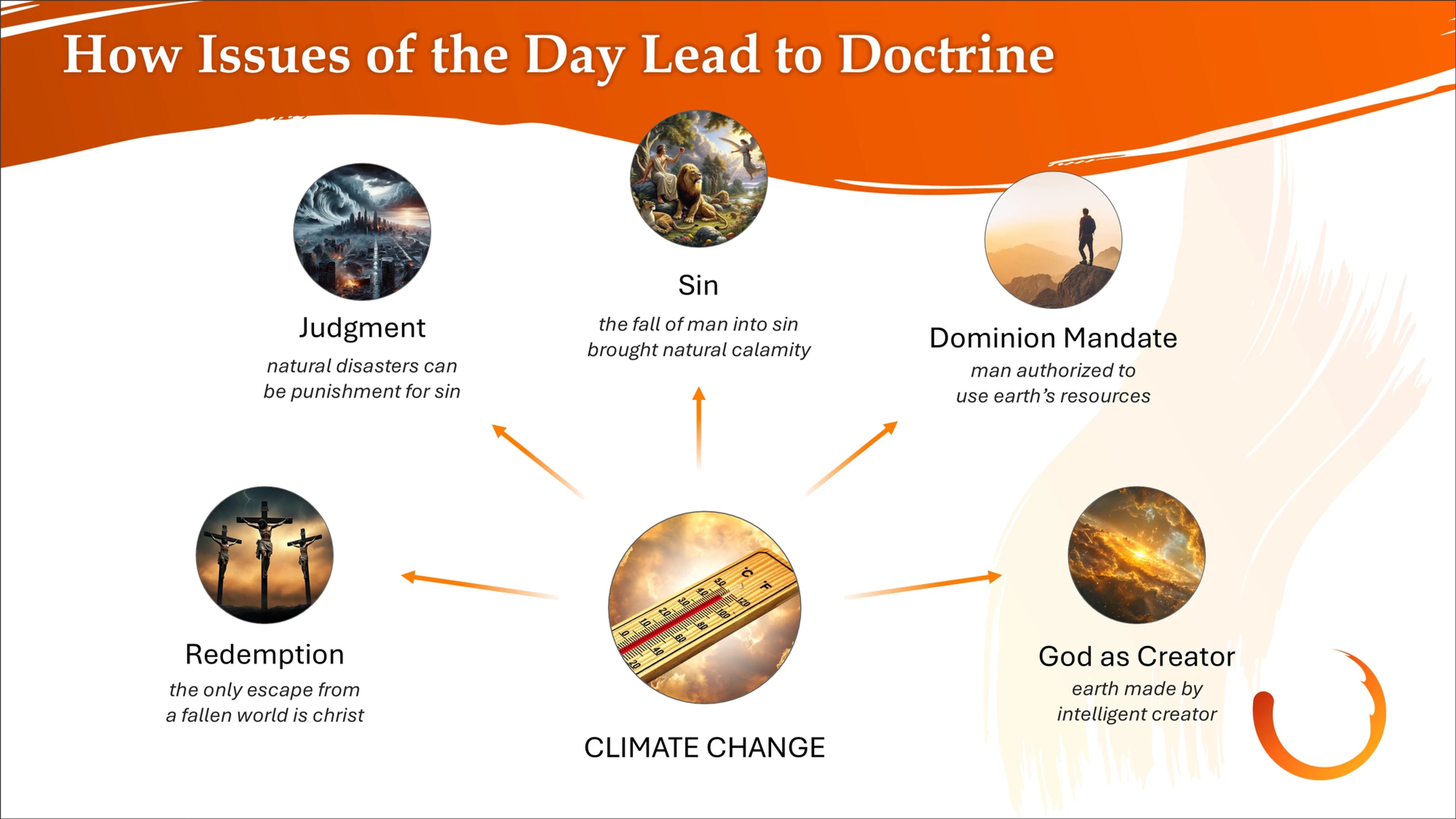
Addressing issues of the day provides an opportunity to present important biblical doctrines in an interesting and unique way, demonstrating that the Bible is both relevant and powerful.
Expository Preaching as the Cure?
“But I am an expository preacher,” someone objects. “I don’t choose my subjects—the Holy Spirit does!”
This is only partially true. Consider all the things the preacher chooses even when he’s going book-by-book, verse-by-verse:
Who chooses the book through which you will preach? The preacher does.
Who chooses which verses/phrases/words to emphasize in a particular passage? The preacher does.
Who chooses which applications to make? The preacher does.
As you can see, expository preachers make many decisions that filter the content of what they preach.
The Main Weakness of Expository Preaching
The primary weakness of expository preaching is that it may never lead to a discussion of the issues of the day.1 Two factors cause this:
1) The preacher himself may avoid them
He does this through the choices he makes regarding the text, as mentioned earlier.
He also does this when he, in order to avoid controversy, intentionally directs his comments away from hot button issues.
In effect, he uses expository preaching to hide from the conflict and persecution that arise because of the Word.
2) The text may never touch directly on the subject itself
For example, where is a verse that will lead directly to a discussion of the tyrannical power of government that socialism creates?2 There isn’t one.
So, using this method alone means you will never address it.3
Expository preaching is fine (as is topical), but preachers must realize they have a greater duty than simply blindly teaching book-by-book, verse-by-verse.
Weakness 2: Sermons are not offensive.
Nobody wants to offend anybody anymore.
The typical preacher’s goal (whether he realizes it or not) is to increase attendance, fill the collection plate, and be liked by everyone he meets.
This means most of the Bible is off limits for preaching, or, at least, the more controversial portions must be watered down so nobody gets mad.
Men of God today have become men-pleasers instead of Christ-pleasers.
But the whole Bible fights against this approach.
God offends men from the very outset of Scripture. Cain, Noah’s flood, the Tower of Babel, Pharaoh, Israel, Judah, Philistia, the Pharisees, Herod—the list has no end.
Our Cross No Longer Offends
Today, we have fallen into the trap Paul was trying to avoid regarding the circumcision issue: causing the offense of the cross to cease.
In Galatians 5:11, he said:
If I still preach circumcision, why do I still suffer persecution? Then the offense of the cross has ceased.
Paul taught that Gentile believers did not need to be circumcised to be saved.
Many of the Jews hated this; to them, the idea Christians were setting it aside was extremely offensive. Because of this, they fought Paul fiercely and persecuted him whenever they could.
Paul could have stopped this abuse if he had just given in. But he refused.
He simply would not allow this true, yet offensive, teaching of the cross to stop.
The truths of the cross must be offensive, and Paul was willing to endure persecution to preach those truths.
The “Scandals” of God’s Word
Interestingly, the word offense in this text literally means “scandal.” What Paul was saying was scandalous, but he did not cease from saying it.
Today, one man/one woman marriage is scandalous, two genders is scandalous, fetuses being human beings is scandalous, women staying home with their children is scandalous, one way to God is scandalous.
And on and on.
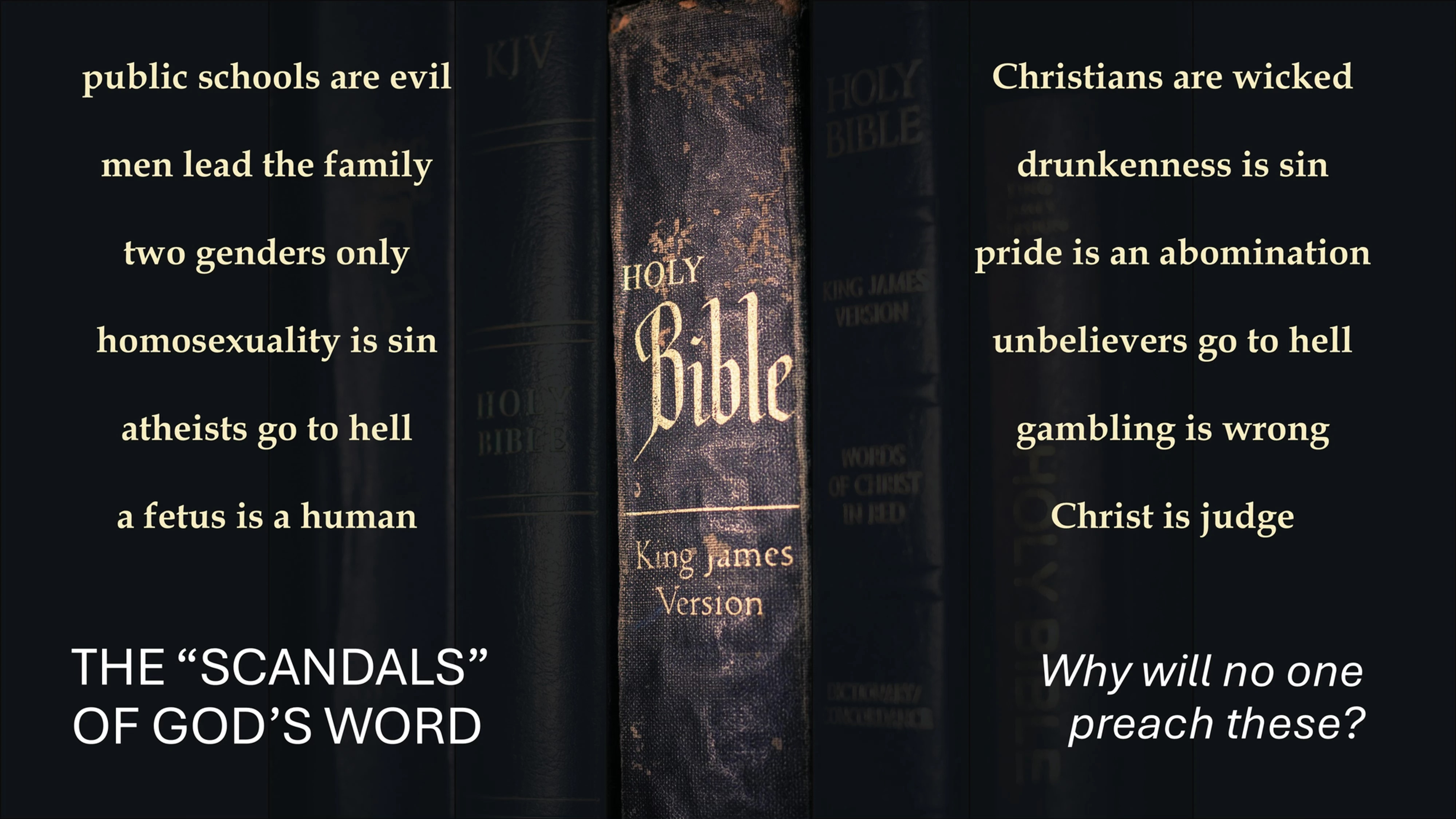
If your preaching isn’t scandalous, you are sinning. You have become a men-pleaser, which, according to Paul, means you are no longer a servant of Christ (Gal. 1:10).
Weakness 3: It is not informed by interaction with the lost.
Part of the reason for errors 1 and 2 is that preachers no longer interact with the lost. Most of them have insulated themselves inside the church and rarely ever come out.
They don’t personally hear the questions the lost are asking or see the sin in which those around them are engaging, so these questions and sins never make it into their sermons.
A Command for Preachers to Evangelize
In 2 Timothy 4:5, Paul issued a very important command relative to this issue. There, he told Timothy to “do the work of an evangelist, fulfill your ministry.”
There is really no way around the implication of this verse for the life of pastors. Paul was directly commanding Timothy, and by extension all preachers, to engage the lost in an ongoing fashion.
It is not an option.
If your preaching isn’t scandalous, you are sinning. You have become a men-pleaser, which means you are no longer a servant of Christ (Gal. 1:10).
An Evangelist, Defined
But what is an evangelist? The word is only used three times in the New Testament, and the only time it refers to an individual is in Acts 21:8 when it discusses Philip.4
And what did he do? He went town to town engaging the lost with the gospel of Christ (Acts 8:5). Philip’s practice, then, becomes our model.
This does not mean we must go about evangelizing just as he did (town to town), but it does require that we engage the lost on a regular basis outside the church.
It also clear from Philip’s example that preaching in a local church on Sunday morning does not fulfill this requirement.
We must go out to the lost, as he did.5
Weaknesses Can Be Made Strengths
The weaknesses outlined in this essay can be easily overcome. But we must be willing to hear the word of God afresh and see things in a way we have not before.
We must break out of the mold of the past and allow God to lead us somewhere new. May Christ give all of his men the grace to do just that.
NOTES:
This is not a rejection of expository preaching. It is a perfectly acceptable approach. However, it is not the only way to preach, and it is not any more “biblical” than preaching topically. It has weaknesses, just as other methods do.
The best approach is to mix these two methodologies to ensure key topics are covered (topical) and that a breadth of Bible doctrines are addressed (expository).
Why should a preacher even care about the power government gains through socialism?
Because Christ directly commands us to care for the poor and protect our fellow man from oppression (Isa. 58:10). Because socialism creates both oppression and poverty, we are commanded to teach about it and fight it.
The Bible addresses this in principle when talking about the nature of man to abuse power (Matt. 20:25, as illustrated in Saul, 1 Sam. 8:11-16), the will of God for people to be treated with dignity (Luke 6:31), and the will of God that men are free to live in godliness (1 Tim. 2:2).
The other two are Eph. 4:11, where Paul says Christ gives the gift of evangelist to the church, and 2 Timothy 4:5, where he commands Timothy to do the work of the evangelist.
Most churches don’t have any lost people coming on Sunday morning anyway, so even if a preacher gave a whole sermon on the gospel, no lost man would hear it.