


A church member walks up to you, opens their Bible to a page of the New Testament, and says, “I know this wasn’t originally written in English. So, where did these words come from, anyway?”
You’re well aware that the New Testament was originally written in Greek and that we’ve got manuscript evidence to support that. But that’s about the extent of your knowledge.
And because of that, you’d probably struggle to provide a thorough, detailed answer, wouldn’t you?
Most believers would.
A Critical Shortfall
There is a significant gap in understanding among pastors, Bible teachers, and Christians regarding the manuscript evidence underlying the New Testament.
References to “the Greek manuscripts” are familiar enough, yet few could specify how many manuscripts exist, how much of the New Testament they preserve, or how close in time they stand to the original writings.
This essay, the third in a five-part series on the New Testament text, aims to address this gap.
Having identified the primary sources of the New Testament (essay 1) and examined the physical and scribal features of those sources (essay 2), the focus now shifts to the value of the manuscripts as historical evidence.
(To read prior essays in this series, go to the New Testament Manuscripts series page.)
Here, our goal is three-fold:
Outline the quantity of manuscripts, the extent of their coverage, and their age relative to the original writings
Compare New Testament manuscript data to that of other ancient documents, specifically, Homer’s Iliad and Odyssey
Consider how this comparison impacts our confidence in the modern New Testament
In this essay:
Premium Resources
Voiceover of Full Essay (via Podcast)
Printable PDF (download below)

New Testament Manuscript Data
Quantity
The organization that identifies, catalogues, and numbers extant manuscripts is the Institute for New Testament Textual Research (INTF), an organization formed in 1958 at the University of Münster in Germany.
Its stated purpose is to “comprehensively document and investigate the history of the transmission of the New Testament in its original Greek.”1
Among other resources, it provides:
The New Testament Virtual Manuscript Room, where Bible students and scholars can review digitized versions of collected manuscripts
The Concise List, the official international registry of all known extant Greek New Testament manuscripts2
INTF manuscripts represent the sole source of manuscript data used in modern Bible translation.
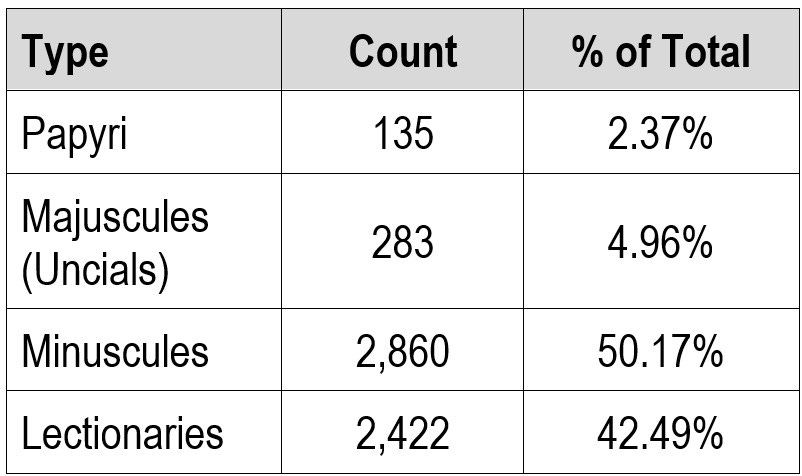
So, how many extant Greek manuscripts are there? Total counts increase every year as more manuscripts are found and logged into the INTF database.
As of September 20233, exactly 5,700 had been identified. The table below provides the official breakdown based on type.4
(For an explanation of the types listed—papyri, majuscules, minuscules, and lectionaries—see essay 2.)
Extant Greek Manuscripts as of September 2023
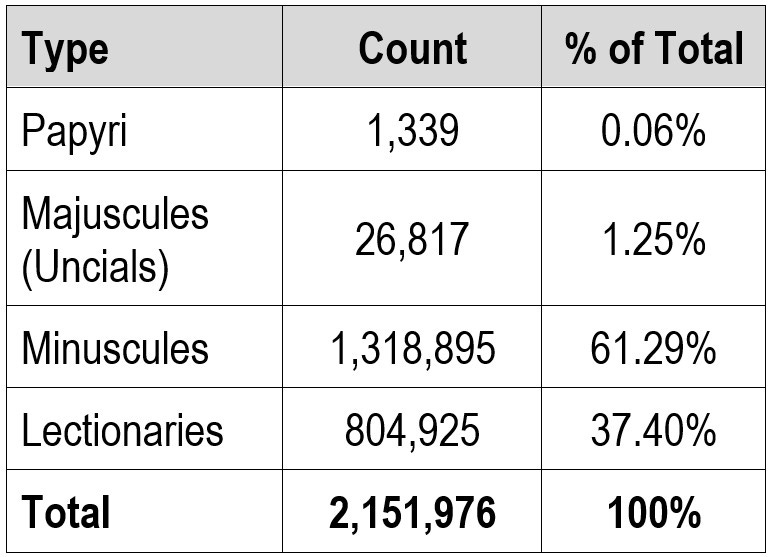
The INTF also publishes data on the total number of pages contained within these manuscripts.
That number as of December 2025 was 2,151,976,5 including “hundreds of witnesses for every book of the New Testament.”6
These break down as shown below.
Manuscript Pages as of December 2025
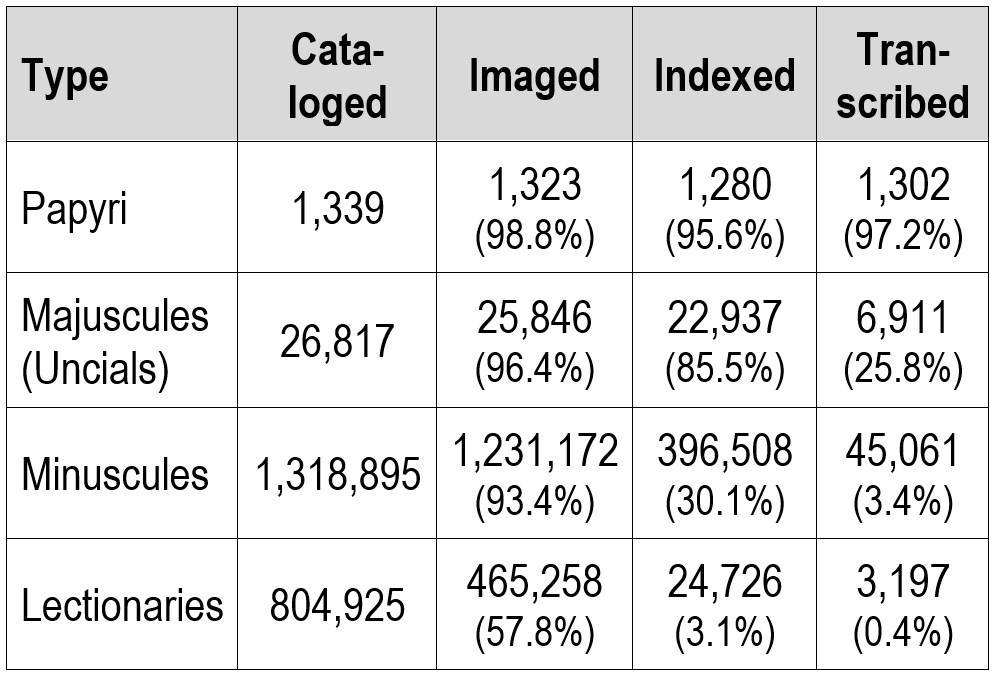
These manuscripts are in one of four stages of processing, identified by the INTF as follows:
Cataloged: The document has been officially registered and given a tracking number.
Imaged: Digital photographs of the pages have been taken, uploaded to the Virtual Manuscript Room, and are viewable online.
Indexed: The contents have been mapped, including the New Testament books contained within them, chapters and verses on specific pages, and gaps in coverage (known as “lacunae”).
Transcribed: Scholars have transcribed each manuscript character by character and entered it into a specialized database, which links the Greek text to the manuscript image with which it is associated. Transcribed manuscripts are used by scholars to further perfect the Greek New Testament used in modern translation.
When this four-fold categorization is considered, the two million plus pages are distributed as indicated in the following table.7
Manuscript Pages by Type and Stage
Size
The size of manuscripts varies widely.
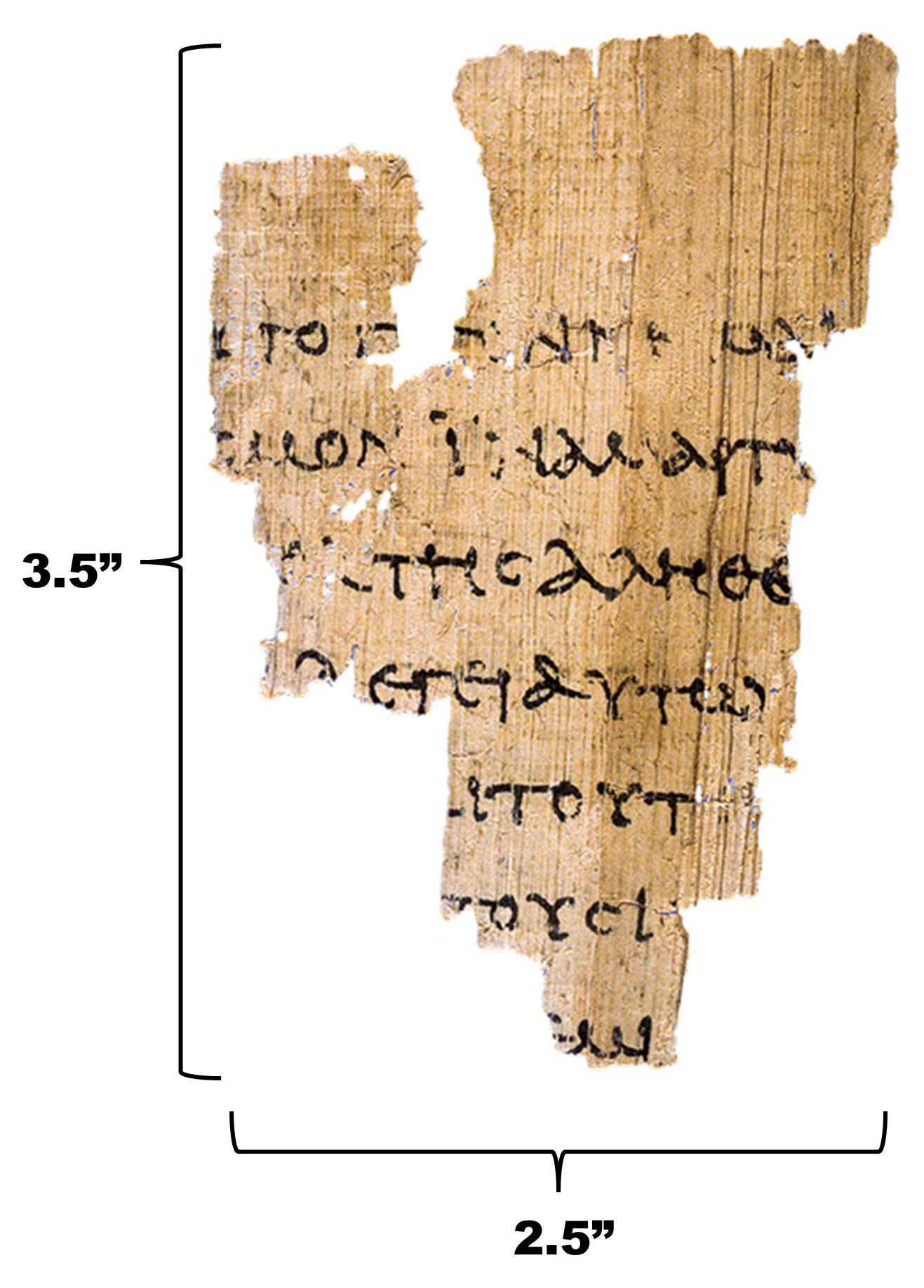
The smallest, known as P52, is 2.5 inches wide by 3.5 inches long8 and contains parts of a few verses on the front and back (front, John 18:31-33/back, John 18:37-38).9
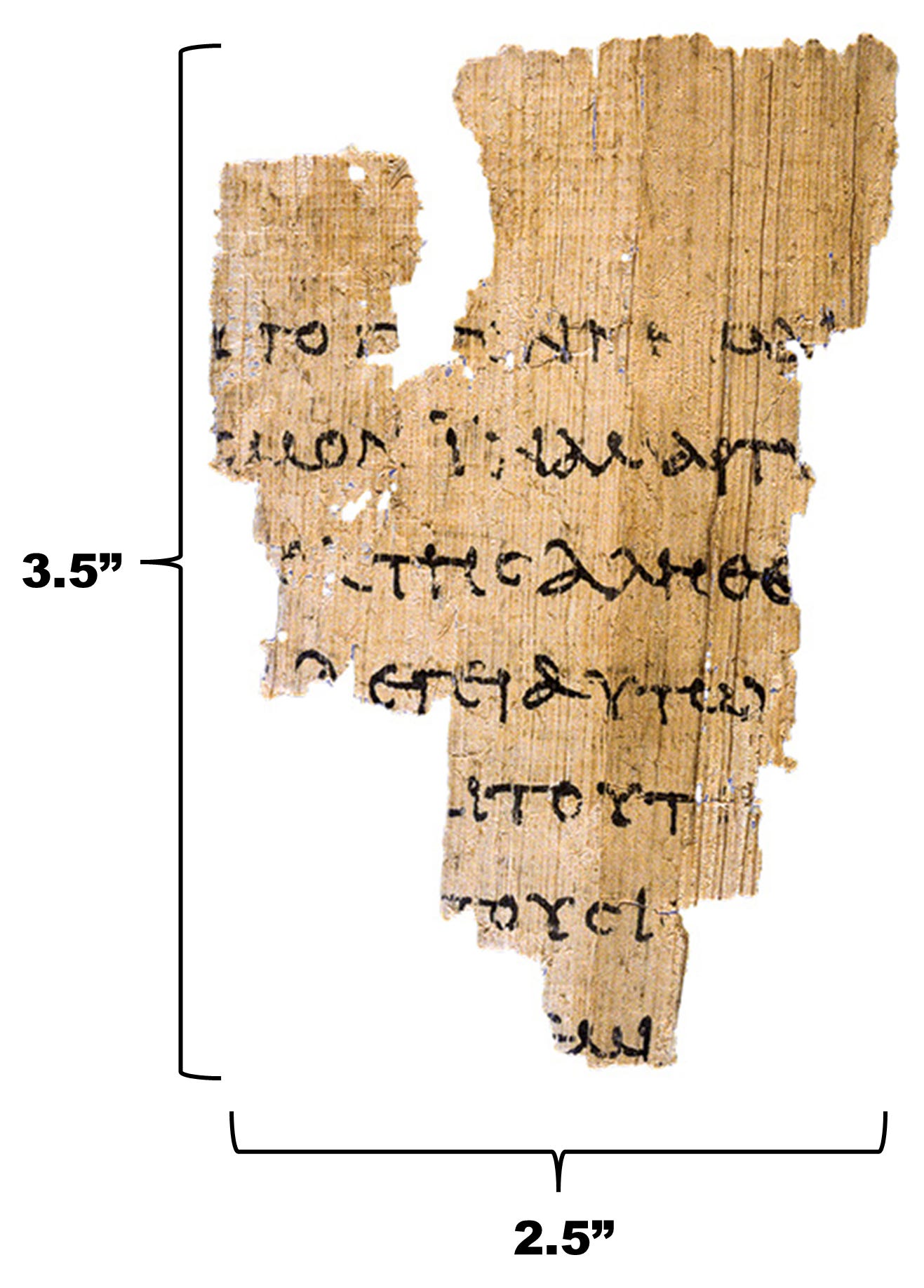
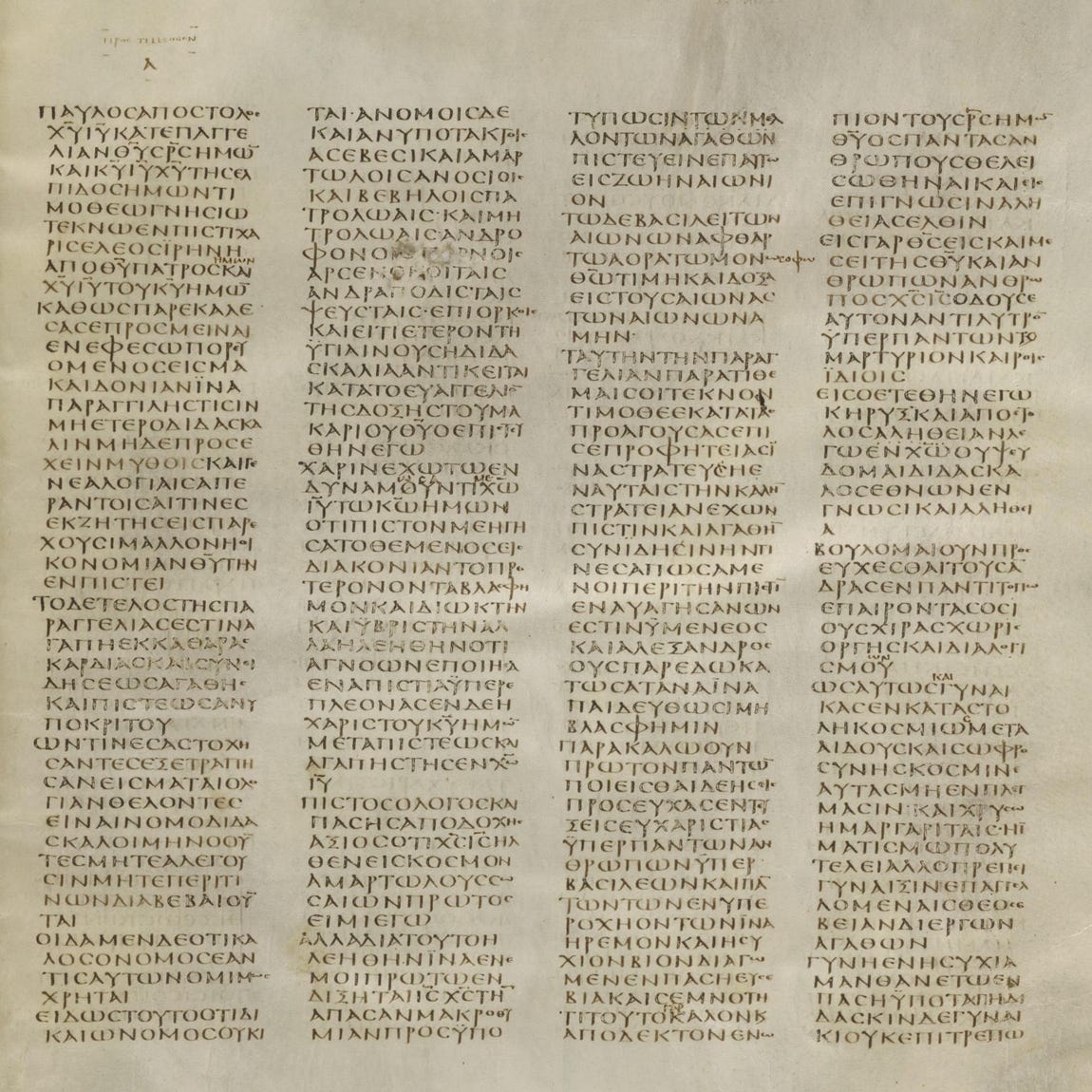
Front face of P52, containing parts of John 18:31-33, with dimensions. The largest, Codex Sinaiticus, contains the complete New Testament, along with large portions of the Old Testament and other non-canonical works, on more than 800 pages (400 front and back) measuring 15 by 13.5 inches.10
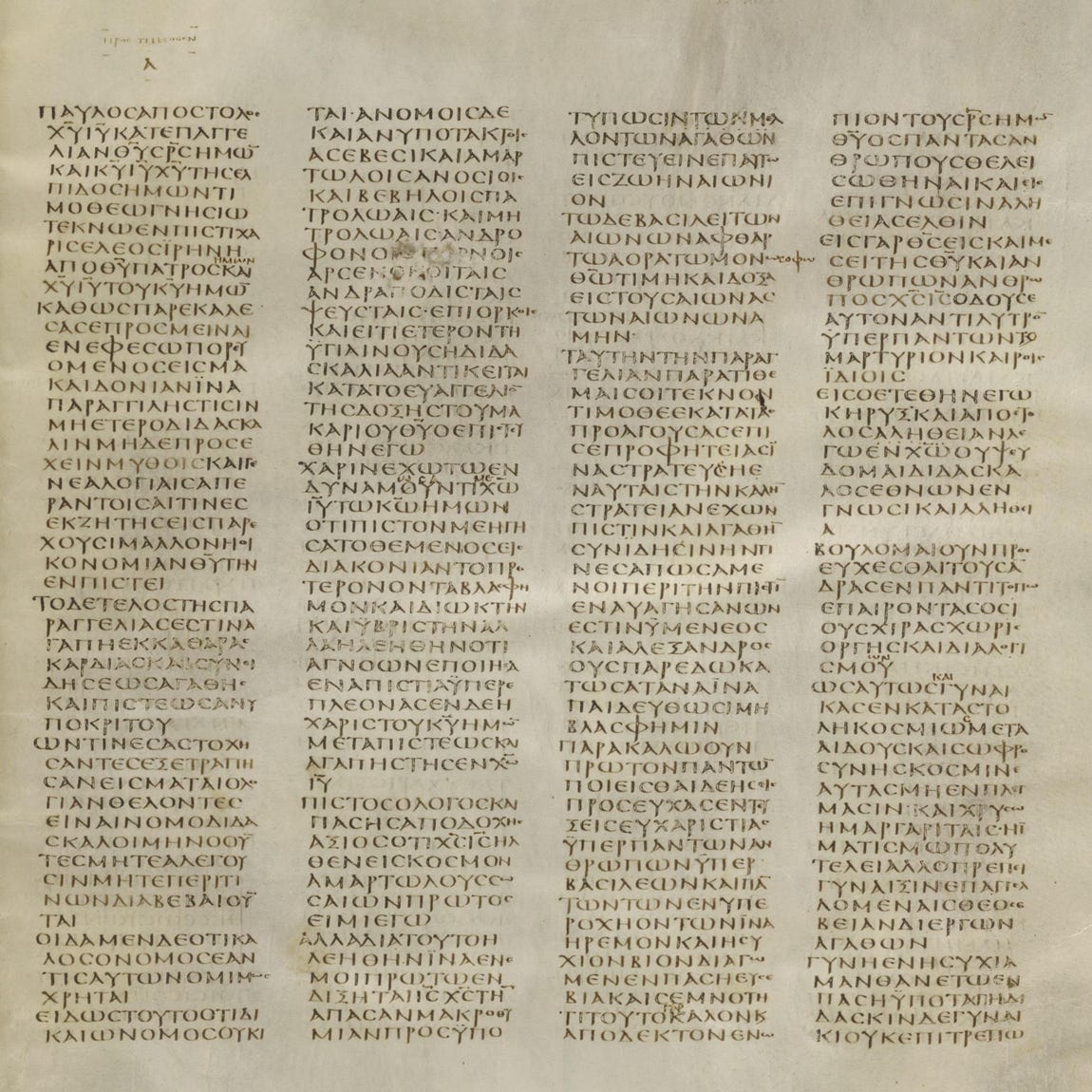
A page from Codex Sinaiticus containing 1 Timothy 1–2:12.
Age
Overall, the copies date from the early second century to the sixteenth century.11
While the majority were produced between the tenth and sixteenth, a significant body of evidence goes back to the second, third, and fourth.
Per Daniel Wallace, there are as many as twenty-four manuscripts from the second century, sixty-four from the third, and forty-eight from the fourth.12
On this early support, he notes:
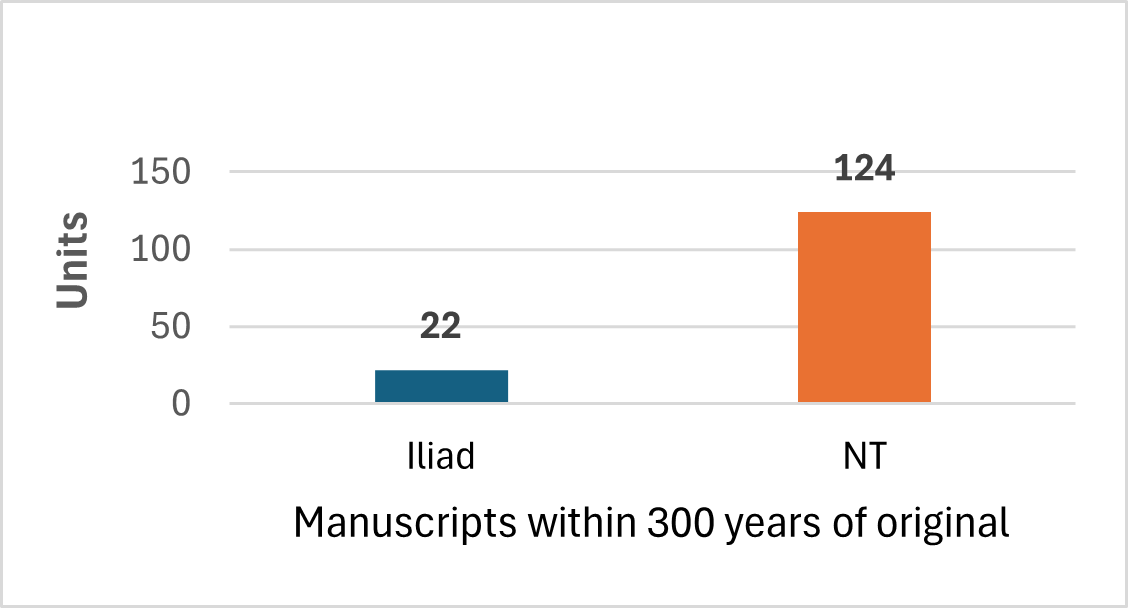
That’s a total of 124 manuscripts within 300 years of the composition of the New Testament.
Most of these are fragmentary, but collectively, the whole New Testament text is found in them multiple times.
[This includes] three out of four gospels, nine of Paul’s letters, Acts, Hebrews, and Revelation.
Regarding the significance of these sources, he observes:
Another way to look at this is that over 40 percent of all the verses in the New Testament are already found in manuscripts within a hundred years of the completion of the New Testament.
Comparison to Homer’s Iliad and Odyssey
How do these numbers compare to the manuscript support for other ancient literary works?
It is not an exaggeration to say that there is no ancient writing in existence with the quantity of manuscripts or those dated as close to the original writings as that of the New Testament.
For comparison, consider the Iliad and the Odyssey, the famous epic poems by the Greek poet Homer.
The Significance of the Iliad and Odyssey
While interest in classic literature has waned in the last half century, scholars are quick to reiterate the influence of works like the Iliad and the Odyssey on Western culture and education.
A University of Chicago museum exhibit had this to say about the impact of these particular works:13
Generations of students have read the Iliad and the Odyssey to learn Greek, to study Greek history, culture, and mythology, or for the sheer enjoyment of the stories and characters.
Concepts such as heroism, nationalism, friendship, and loyalty have been shaped by Homer’s works.
Countless editions, translations, abridgements, and adaptations have appeared since the invention of printing, making Homer accessible to students, scholars, children, and general readers.
Notice the amount of study done on these documents, the character traits they have influenced, and the “editions, translations, abridgements, and adaptations” that have been produced related to them.
Clearly, the impact of these writings has been widespread and profound. But what kind of manuscript support stands behind them?
Support for the Iliad and Odyssey
Both poems are set during or just after the Trojan War.
The Iliad traces the exploits of Achilles near the end of the war, while the Odyssey focuses on Odysseus’ journey home just after it ended.


Both poems originated as oral compositions in the late eighth to early seventh centuries BC and were not committed to writing until the mid-sixth century BC.14
Like the New Testament, they have early papyri manuscript witnesses, copies from later centuries, and quotations that appear in other works.
Early Papyri Witnesses
The earliest papyri evidence dates to the third century BC, with another 300 medieval manuscripts from the ninth to fifteenth century AD.15
Moreover, the earliest complete text of the Iliad, the most well-documented of the two, is from the tenth century AD.16
This creates the following gaps in the transmission record:
300-400 years from the first written forms to the earliest known manuscripts
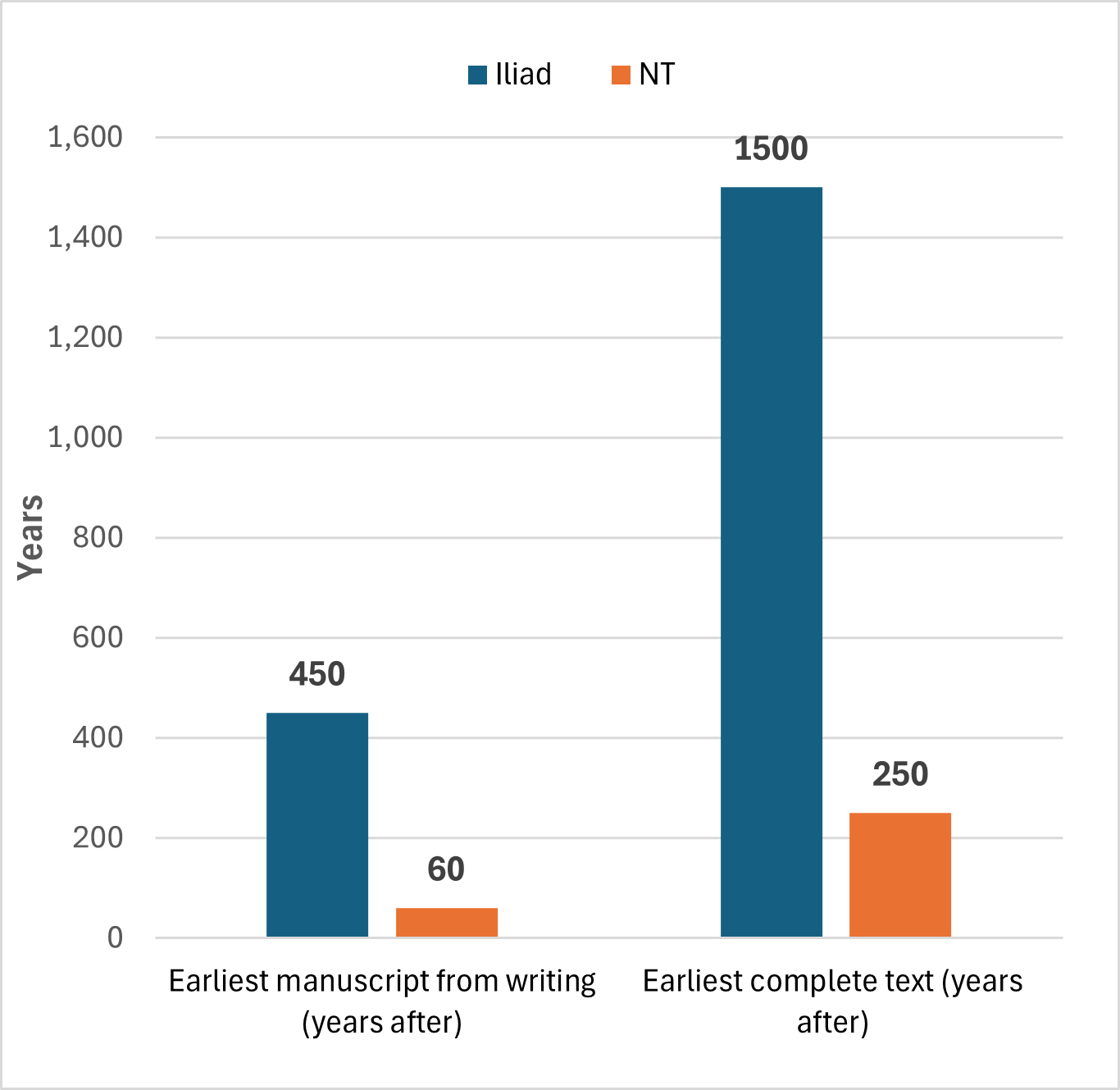
400-500 years from the composition of the poems to the earliest known manuscripts
1400-1500 years from the first written forms to the oldest complete text
1500-1600 years from composition to the oldest complete text
Homeric scholar M. L. West affirmed the existence of such gaps:
In most cases we rely on manuscripts written in the Middle Ages or Renaissance, many centuries later than the original authors.
In the case of Homer, they are over 1,500 years later.17
Not only is there a gap between the original content and the manuscript evidence, but there is also a gap in the evidence itself.
West notes how the lack of interest in classical poetry during the early part of the Middle Ages brought copying to a halt.
There is a gap in the tradition between the sixth and the ninth century: no more papyri, and no other manuscripts either.
It was a period during which interest in classical poetry evidently lay dormant.18
Total Papyri vs the New Testament
Cumulative papyri counts are worth noting, as well. The earliest witnesses total only 1,550 for the Iliad and 566 for the Odyssey.19
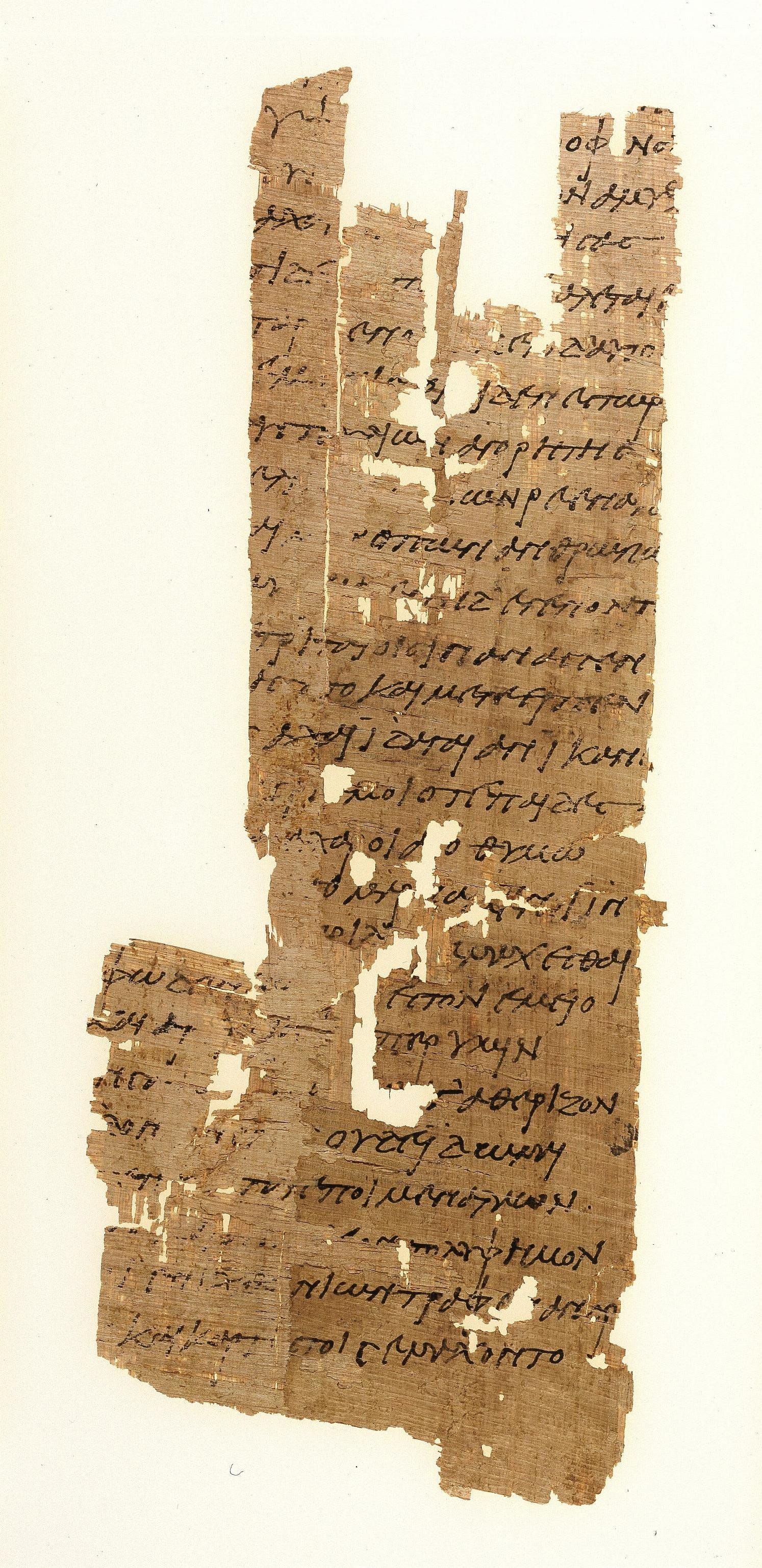
Graeme D. Bird, in his 2010 book Multitextuality in the Homeric Iliad, provides a helpful chart showing the distribution of Iliad papyri over the centuries.
There, he identifies one from the fourth century BC, twenty from the third, eighteen from the second, and forty-eight from the first. The total of all papyri, per his count, is 1,326.20
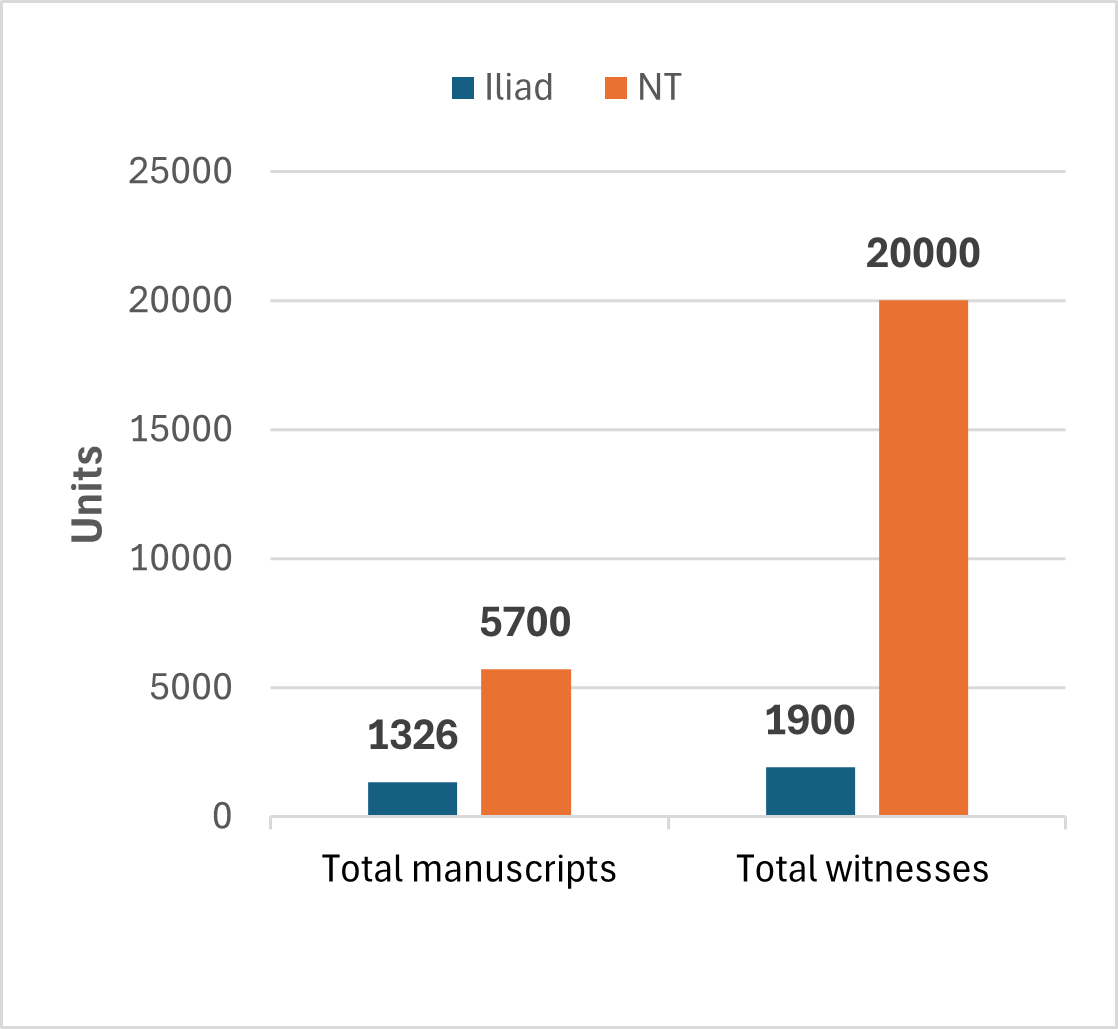
This 1,326 number seems significant at first blush, especially considering that total New Testament papyri is only 135.
It is important to keep in mind, however, that there are not hundreds of manuscripts to compare for any given portion.
On the contrary, the overlapping coverage of the Iliad makes it possible only to compare as many as ten manuscripts for any given text (and only five for the Odyssey).21
The much smaller count of New Testament papyri, however, means one can review “the whole New Testament text…multiple times” from this source alone.22
Overall Limited Support
When other types of non-papyri manuscript evidence are considered, the total number of documents supporting the Iliad is only 1,900, and those were produced over a 2,000 year span.23
Bird characterizes the scant amount of total evidence like this:
Whatever the factors responsible for this state of affairs, our examination of the Ptolemaic papyri [earliest surviving manuscripts] must bear in mind that our surviving amount of evidence is tiny, and cannot automatically be assumed to be a “representative sample.”24
Comparison to the New Testament
Now, let’s compare Homer’s Iliad with the New Testament in terms of manuscript attestation.
The following charts visualize this comparison in terms of total manuscripts and witnesses, earliest manuscript and complete text, and manuscripts within 300 years of the original writing.
Total Manuscripts and Witnesses
Earliest Manuscript and Complete Text
Manuscripts within 300 Years of the Original
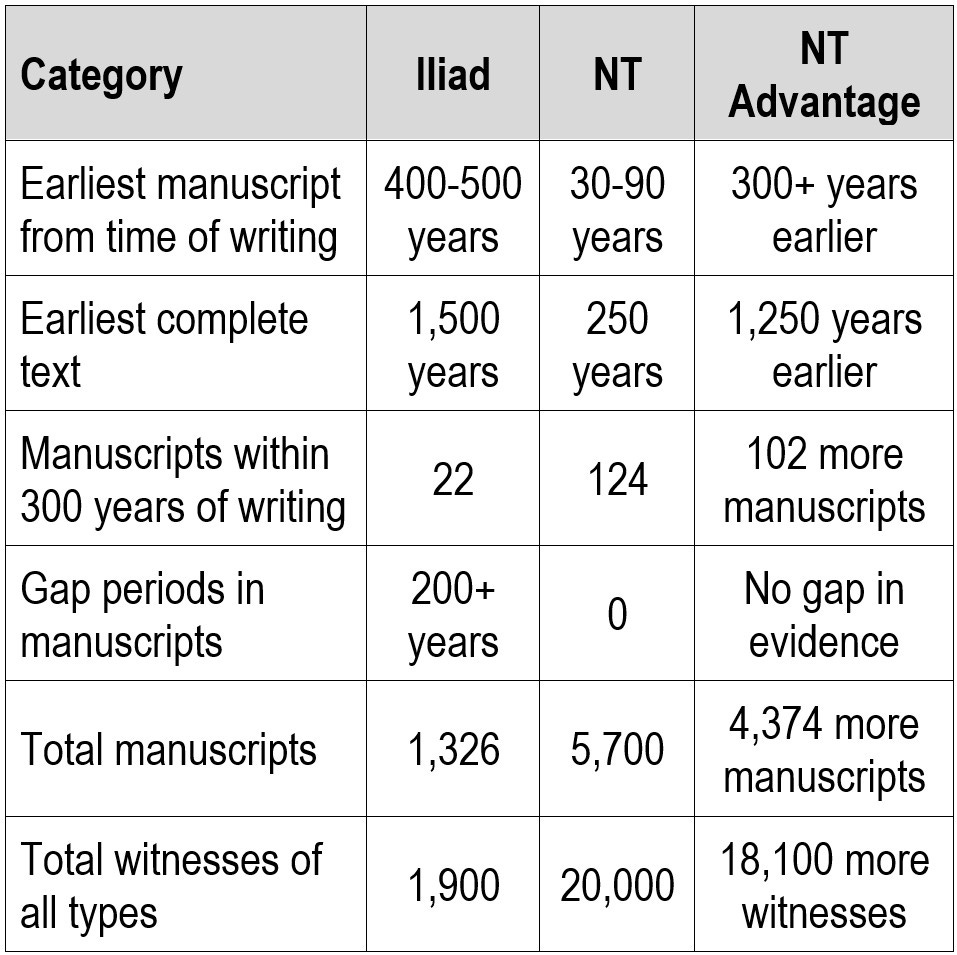
The following table summarizes the points provided in the charts above and adds a comparison related to gaps in the manuscript evidence.
The New Testament: The Clear Winner
By every measurable criterion, the New Testament’s manuscript support exceeds that of the Iliad.
Its earliest manuscripts date to within a century of composition (compared to four to five centuries for the Iliad)
Its earliest complete text is more than a thousand years closer to the autographs
Its transmission shows no comparable gaps
Its total number of witnesses exceeds that of the Iliad more than tenfold
Effect on Our Confidence in the New Testament
This evidence supports confidence in the textual basis of the New Testament.
When judged by the historical standards applied to other ancient literature—texts that are read, copied, and studied without hesitation—the New Testament stands out for the exceptional strength of its textual support and fully warrants the confidence long placed in it.
Daniel Wallace’s comments on this point serve as a fitting conclusion to our discussion:
In terms of extant manuscripts, the New Testament textual critic is confronted with an embarrassment of riches.
If we have doubts about what the original New Testament said, those doubts would have to be multiplied a hundred-fold for the average classical author.
And when we compare the New Testament manuscripts with the very best that the classical world has to offer, it still stands head and shoulders above the rest.
The New Testament is far and away the best-attested work of Greek or Latin literature from the ancient world.25
Conclusion
The evidence surveyed in this essay demonstrates that the New Testament rests on an exceptionally strong manuscript foundation by ancient historical standards.
In terms of quantity, extent of coverage, and chronological proximity to the original writings, it is supported by a body of evidence unmatched among ancient literary works.
The number of extant manuscripts, their overlapping coverage, and the presence of witnesses reaching back into the second and third centuries provide a solid basis for textual study.
When set alongside other respected works of antiquity, such as the writings of Homer, the New Testament emerges not as marginal or poorly attested, but as a text preserved with remarkable historical continuity.
At the same time, a large and early manuscript tradition does not imply textual uniformity. Variations among manuscripts remain and must be evaluated with care.
The fourth essay in this series will therefore turn to the types of manuscript variation found in the New Testament and their significance for the text.
Understanding the strength of the manuscript evidence alongside the nature of its differences is essential for a balanced assessment of how the New Testament has been transmitted and preserved.
NOTES:
Institute for New Testament Textual Research. “Institute.” University of Münster, https://www.uni-muenster.de/INTF/institut/index.html.
These sites are in German, so you will need to use the translating function of your browser to read them in English. Google Chrome and Microsoft Edge have this feature built-in and may do this automatically for you.
The INTF does not publish an ongoing count of current manuscripts. This can only be identified by using the complex search function in the Contact List. At this time, I am unable to use this system in a way that provides reliable counts, so I am deferring to a post provided by the INTF from 2023, cited below.
Katie Leggett and Greg Paulson. “How Many Greek New Testament Manuscripts Are There REALLY? The Latest Numbers.” New Testament Virtual Manuscript Room, Institute for New Testament Textual Research, University of Münster, 29 Sept. 2023, https://ntvmr.uni-muenster.de/intfblog/-/blogs/1891824. Accessed 21 Dec. 2025.
Unlike manuscript counts, the INTF does publish an up-to-date summary table of manuscript pages. The data cited is current as of this writing.
Robert B Stewart, ed. “The Textual Reliability of the New Testament: A Dialogue.” The Reliability of the New Testament: Bart D. Ehrman and Daniel B. Wallace in Dialogue, Fortress Press, 2011, p. 33.
New Testament Virtual Manuscript Room, Institute for New Testament Textual Research (INTF), University of Münster, https://ntvmr.uni-muenster.de/home. “Statistics – Manuscript Pages” graph (top right). Accessed 2 - Darker Dec. 2025.
Stewart, Textual Reliability, 18.
“Earliest New Testament Fragment.” Biblical Archaeology Society Library, https://library.biblicalarchaeology.org/sidebar/earliest-new-testament-fragment/. Accessed 22 Dec. 2025.
“Codex Sinaiticus.” Smithsonian’s National Museum of Asian Art, https://asia-archive.si.edu/exhibition/codex-sinaiticus/. Accessed 22 Dec. 2025.
Bart D. Ehrman. “Textual Criticism of the New Testament,” in Hearing the New Testament, ed. Joel B. Green (Grand Rapids: Eerdmans, 1995), 129.
Stewart, Textual Reliability, 34.
“Homer, Print Transmission, and Reception: Homer’s Works.” University of Chicago Library, https://www.lib.uchicago.edu/collex/exhibits/homer-print-transmission-and-reception-homers-works/. Accessed 22 Dec. 2025.
“Homer, Print Transmission, and Reception.”
Ibid.
Graeme D. Bird. Multitextuality in the Homeric Iliad: The Witness of the Ptolemaic Papyri. Center for Hellenic Studies, 2010, https://chs.harvard.edu/read/bird-graeme-d-multitextuality-in-the-homeric-iliad-the-witness-of-the-ptolemaic-papyri/. Accessed 26 Dec. 2025.
Martin L. West. “Editing the Odyssey.” The Winnowing Oar: New Perspectives in Homeric Studies, edited by Franco Montanari and Antonios Rengakos, Brill, 2017, p. 13, https://www.degruyterbrill.com/document/doi/10.1515/9783110559873-002/html. Accessed 29 Dec. 2025.
Ibid.
Ibid.
Bird, Multitextuality in the Homeric Iliad.
West, “Editing the Odyssey,” 13.
Stewart, Textual Reliability, 34.
Bird, Multitextuality in the Homeric Iliad.
Ibid.
Stewart, Textual Reliability, 34.