


Skeptics today doubt every conceivable aspect of the New Testament. They doubt that Jesus existed, they doubt that miracles are possible, they doubt the resurrection.
On a more fundamental level, they doubt we can even know what the original New Testament authors wrote in the first place. Answering that question is what this essay series is all about.
In the previous essay, we surveyed the three primary sources that preserve the New Testament’s text and saw how they form a remarkably rich and interlocking witness.
Yet knowing that manuscripts exist is only the starting point.
To evaluate their significance, we must understand what kind of manuscripts they are, how they were produced, and how their physical features help scholars assess their age and reliability.
This essay turns to that task by examining the formats, materials, and handwriting styles of the Greek manuscripts themselves.
In this essay:
Early Access Note: At launch, long-form essays are available in full; future essays will be reserved for paid subscribers, who will also receive the full audio edition and printable PDF.
Copying Formats
When scholars refer to the Greek manuscripts we physically possess today (as opposed to ones that have been lost to time), they call them “extant.” The term comes from the Latin exstāre, meaning “to stand out or be in existence.”1
Extant New Testament Greek manuscripts appear in three forms: direct copies, palimpsests, and lectionaries.
Premium Resources for Paid Subscribers
Voiceover of Full Essay (via Podcast)
Printable PDF (download below)

Direct Copies
Direct copies are reproductions made for the sole purpose of recreating the New Testament. No additional material is added to the copy itself, and it exists for no other purpose than to reflect the content of the original.
It is the equivalent of copying a sheet of paper on a copier—whatever you start with, you end with. Direct copies date from the second century through the sixteenth.


Palimpsests
Palimpsests (pronounced pal’-imp-sest) are copies that have been erased and copied over with some other writing.2
How Palimpsests Were Made
Parchment, a common type of ancient writing material, was durable enough to allow the original ink to be scraped off so that the page could be reused. (The word palimpsest comes from two Greek words meaning “to scrape again.”)
In many cases, the scraping process did not fully erase the original writing (the “undertext”), so the text underneath (the “overtext”) could still be read.3
Imagine you write a recipe on a piece of paper with a pencil. Then you decide not to make it, so you erase it, and write a grocery list on the same page instead. Later, you determine to make the recipe after all, and you find you can still read it under the grocery list.
This is the idea behind a palimpsest.
Important Palimpsests
Some important manuscripts appear in the form of palimpsests. One of the most famous is Codex Ephraemi Rescriptus, a fifth century copy of the Old and New Testaments.
The image below shows a page from this codex with both the undertext and overtext clearly visible. To see more pages from this codex, and to view zoomable images of these pages, see the Codex Rescriptus page on The Center for the Study of New Testament Manuscripts’ site.
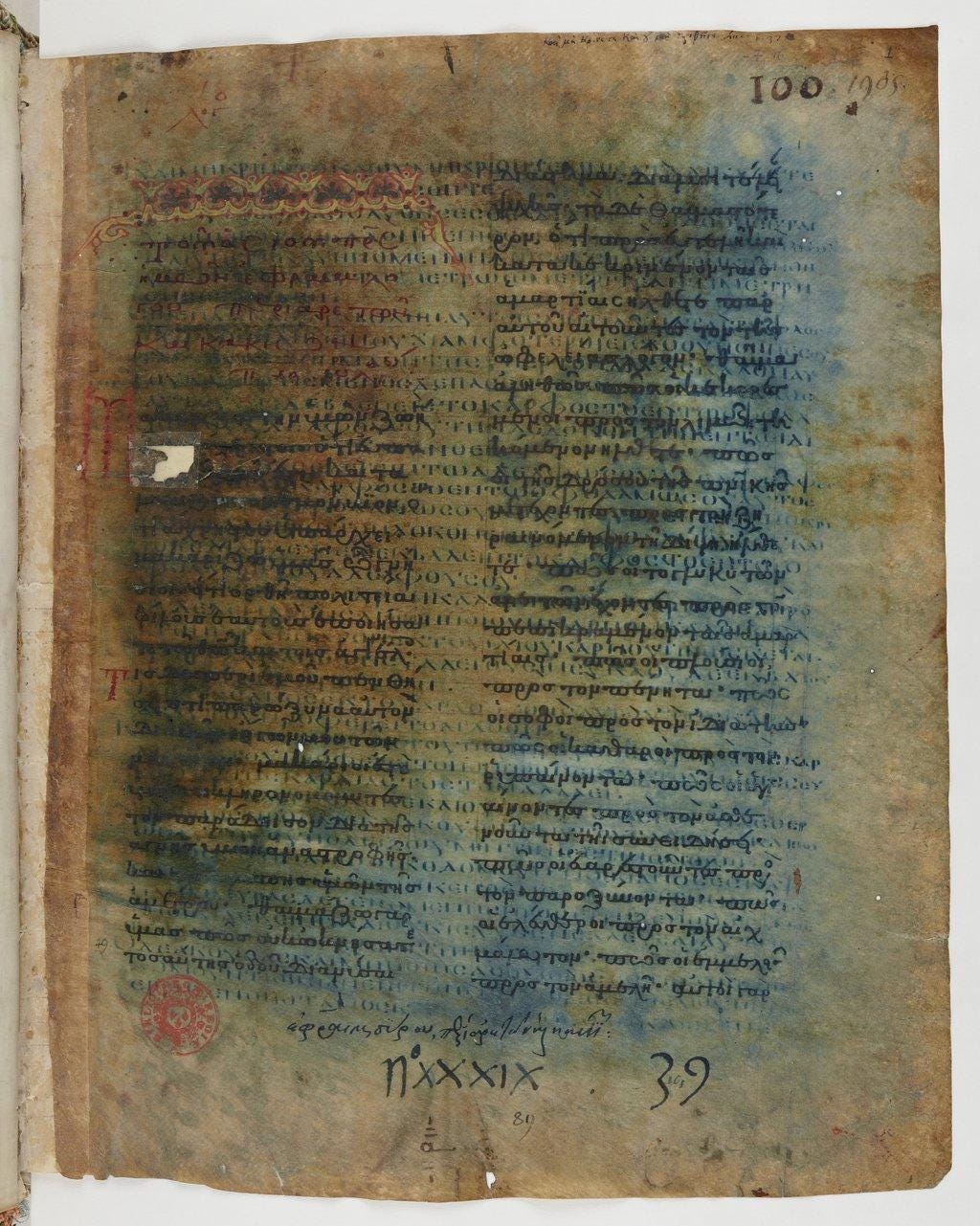
In the twelfth century, the biblical text was erased and some of the pages copied over with writings of Saint Ephraem Syrus, a fourth century Catholic theologian.4 The remaining portions contain parts of every New Testament book but 2 Thessalonians and 2 John.5
Overall, palimpsests date from the fifth century to the ninth for the original text and ninth through thirteenth for the new.6
Lectionaries
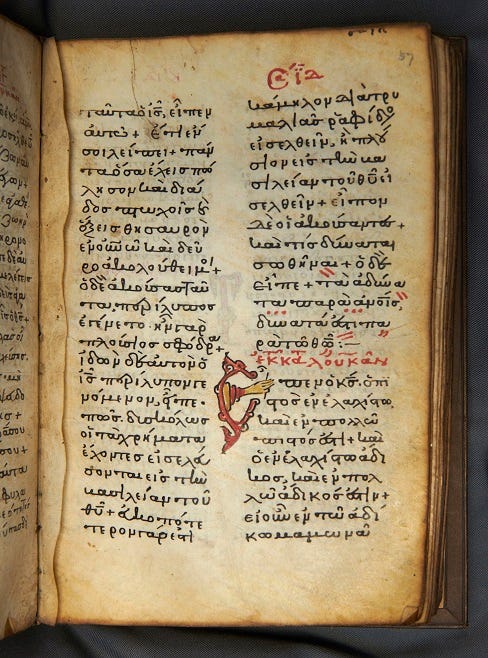
Lectionaries are documents containing specific New Testament passages that were read in church services at various times and contexts.7 The root word lection comes from the Latin word lēctiō, which means “a reading.”
A lectionary, then, is a group of readings. These date from the ninth to sixteenth century and fall into several categories:8
Synaxarion: Daily readings or those which revolve around Easter
Menologion: Readings for special occasions such as feasts and saints’ days
Evangelistarion: Readings from the gospels only
Apostolicon: Readings from non-gospel portions, except Revelation
Writing Materials
Documents at the time of the New Testament were written on two types of material—papyrus and parchment—and organized into two types of books—scrolls and codices.
Material types
Papyrus
Papyrus was a rough grade of paper made from the papyrus plant, a reed which grew in Egypt along the Nile. The center of the stalk was cut into strips, which were laid side by side to form the base of a sheet.


Another set of strips was placed on top at a right angle. The two-ply unit was moistened, hammered, and dried in the sun, forming a sheet of 6 by 9 inches to 12 by 15 inches.9
Writing generally occurred on the side with fibers running horizontally, known as the recto, with a pen made from a reed. The recto was placed on the inside of the scroll or book.
The fibers running vertically, known as the verso, were placed on the backside and were normally not used for writing due to the difficulty of writing across the grain of the papyrus strips.10
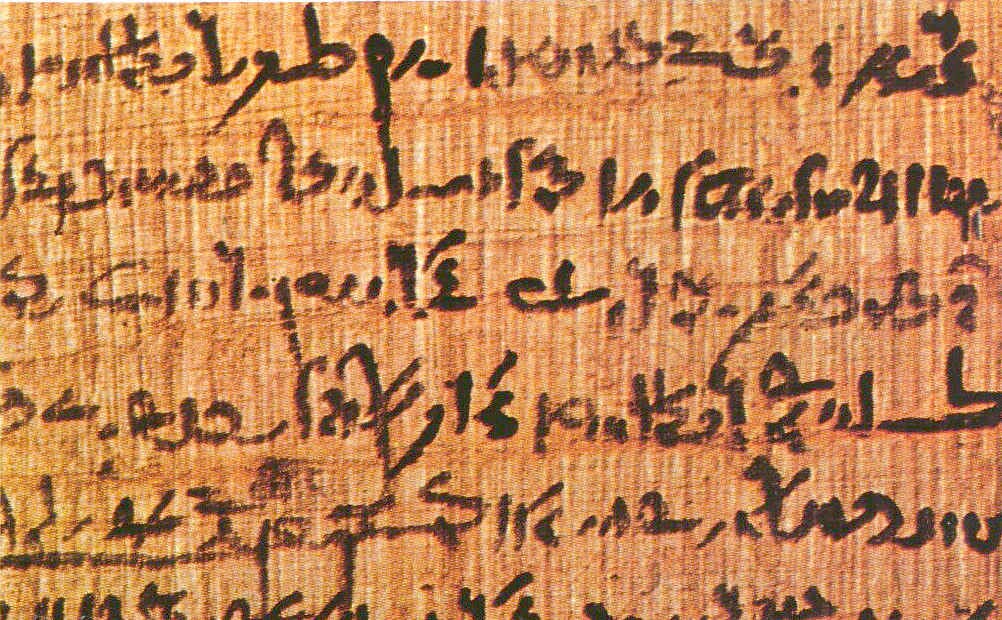
Papyri copies are the earliest manuscripts that exist of the New Testament, dating from the second to the fifth centuries.11 Two of the most significant papyri collections are the Chester Beatty Collection and the Bodmer Library Collection.
Chester Beatty: Contains large portions of the New Testament dating from the third century, including the gospels, Acts, and Paul’s non-pastoral epistles.
Bodmer Collection: Includes the oldest New Testament fragment ever found, designated P52, dated to the first half of the second century, as well as the “oldest extensive manuscript of any part of the New Testament,” P66.12
Parchment
The second major writing material during the New Testament period was parchment, a base produced from animal skins.
The skins, most often from sheep or goats,13 were scraped, soaked in quick lime, and rubbed with chalk and pumice stone, which produced a thin, firm, and very durable writing surface.”14 The surface could be written on with a quill or reed pen.15
Per Greenlee, “beginning in the fourth century, parchment almost completely displaced papyrus as the writing material for New Testament manuscripts.”16
The most famous parchments are Codex Sinaiticus and Vaticanus from the fourth century (330-360 and 300-325 AD), respectively17, Codex Alexandrinus from the fifth century (400-440 AD18), and the palimpsest, Codex Ephraemi Rescriptus, mentioned earlier, from the fifth century.
Book Types
Longer writings exceeded the space provided by a single sheet of papyrus or parchment. Therefore, individual sheets were bound together in a scroll or codex to allow them to be collected, transported, and read.
Scroll
A scroll was a book where sheets of text were fastened on the edges of the vertical sides to form a continuous roll.
In the case of papyrus, the sheets were slightly overlapped and glued together, generally in a roll of twenty sheets19; parchment pages were sown together.20
The text appeared on the inside of the roll and was written in narrow columns. This allowed the user to read the contents without having to open the scroll very far.21
Codex
A codex, on the other hand, was more like a modern book, with single pages bound together on one side.
Long before New Testament times, wax tablets had been used for schoolwork and temporary writing (much like a chalk board or Post-It note).
Eventually, these tablets were joined by strings looped through holes on the edges, forming a rudimentary notebook. This led to the practice of combining papyrus and parchment sheets in the same manner to form codices of literary works and manuscripts.22
Codices had many advantages over scrolls.23
Accessing a single page did not require the cumbersome process of turning through the rolled up text of a scroll; the reader could simply open to a specific page.
Writing could be placed on both sides of the page, increasing the amount of text it could accommodate.
Long documents or written works could be contained in a relatively small space.
New Testament Uses
During the time of Christ and the apostles, the papyrus scroll was the accepted form for serious literary works, while the codex was reserved for non-literary and personal writings.
This likely led to different New Testament books being published in different forms. J. H. Greenlee addresses the possible dichotomy in his review of New Testament manuscripts24:
The books of the New Testament that were more nearly literature as they were published, such as the gospels and Acts, may have been written on scrolls in accordance with the current literary tradition; whereas those that were more nearly personal communications, such as the letters of Paul, may have been written in codex form.
Handwriting Types
Another way of evaluating manuscripts is by considering the type of handwriting used to produce them. An understanding of these types, along with the time of their use, assists scholars in determining the age of the manuscript.25
From the New Testament period onward, two main types of Greek handwriting were prevalent, majuscule and miniscule.
Majuscule
Majuscule writing employed all capital letters, with no adjoining strokes and no spaces between words26 (an approach called scriptio continua).27 If we were to use it today, I T W O U L D L O O K L I K E T H I S.
It likely developed from writing used on stone tablets, columns, or buildings28 and was very common in the ancient world from long before the time of Christ.29

Majuscule was not simply a way of writing Greek text, however. It was also used in other languages, particularly Latin.
Roman Square Capitals
Roman Square Capitals was a Latin version used for monuments, inscriptions, and other non-literary text.30
The inscription at the base of Trajan’s Column, a monumental stone column built in 113 AD to commemorate Emperor Trajan’s victories in the Dacian Wars, uses this majuscule (see image below).


Rustic Capitals
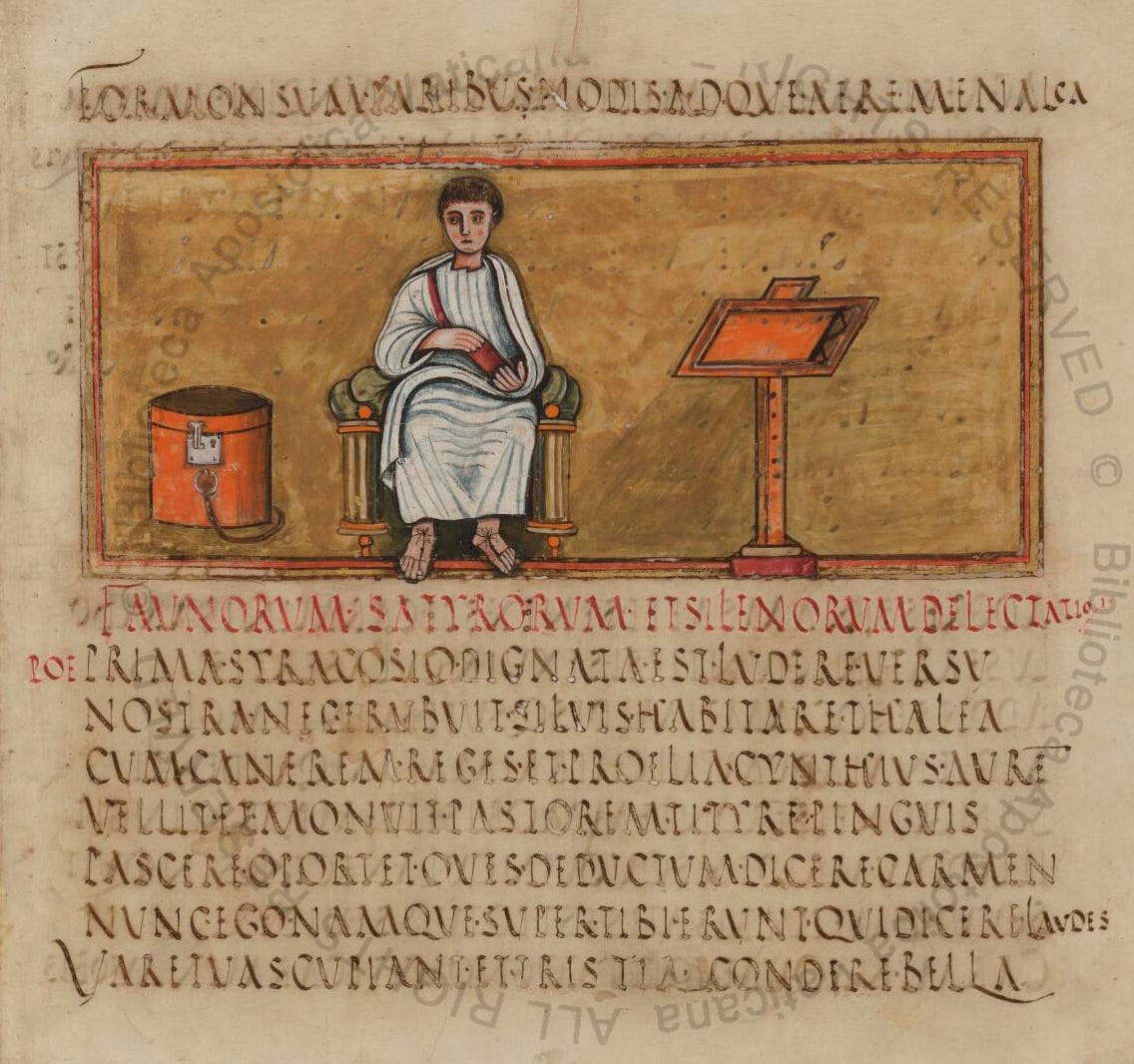
Rustic Capitals, on the other hand, was a more formal version used for literary works in the early Roman period.31
Vergilius Vaticanus (Vatican Vergil), a late-4th-century manuscript with some of the earliest surviving narrative illustrations in a Western text, is the most famous ancient work using this form of majuscule (see image below).
Non-biblical Greek majuscules date to the fourth century BC32 and were used in many types of book writing, including classical Greek literature, historical accounts, and philosophical and scientific texts.
And, although the style and tradition varied slightly from the literary form, it was also used extensively in carvings for temple dedications, public decrees, and tombstones.
Biblical Majuscule
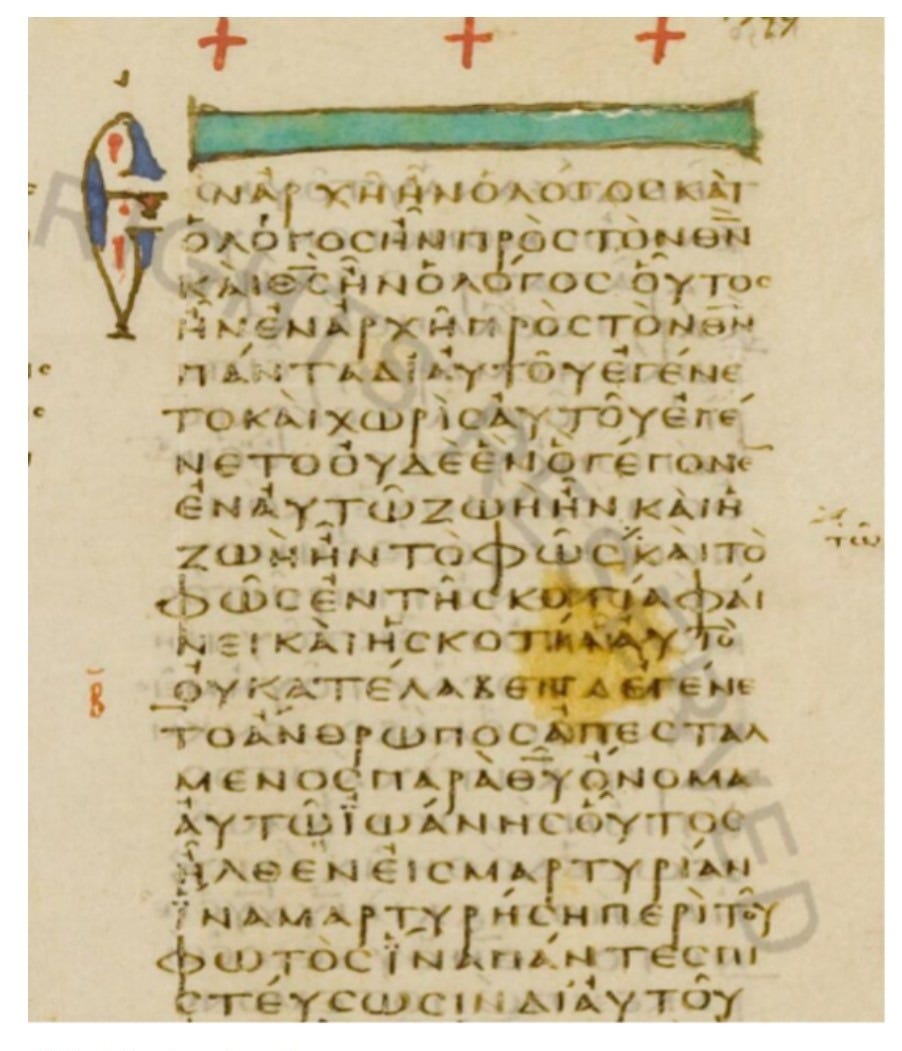
Early on, copies of the New Testament were made using standard Greek majuscule, as evidenced by extant papyri fragments dating from the third century.33 By the fourth century, however, a specialized form of Greek majuscule had developed, known as “biblical majuscule.”34
Bates described it this way:
This was an elegant script with careful attention paid to the sizing and placement of the letters and allowed the biblical text to be produced in a true “literary” style. This script is best seen in the great codices of the fourth and fifth centuries, like Codex Vaticanus.35
Greenlee comments on the significant role of majuscules in New Testament documentary history:
The New Testament [documents] that were written for publication, such as the gospels, were presumably written in uncial [a synonym for majuscule] letters. …
Even the very earliest extant manuscripts of the Pauline letters, as of all the New Testament, are written in uncials.
For practical purposes, therefore, it may be said that the transmission of the New Testament was in uncial manuscripts from the beginning.36
Miniscule
Majuscule letters created issues in producing fast, low-cost copies, however. The large letters took up significant space on the page and were tedious and time-consuming to write.37 These problems were solved with the advent of a form of writing known as “miniscule script.”38
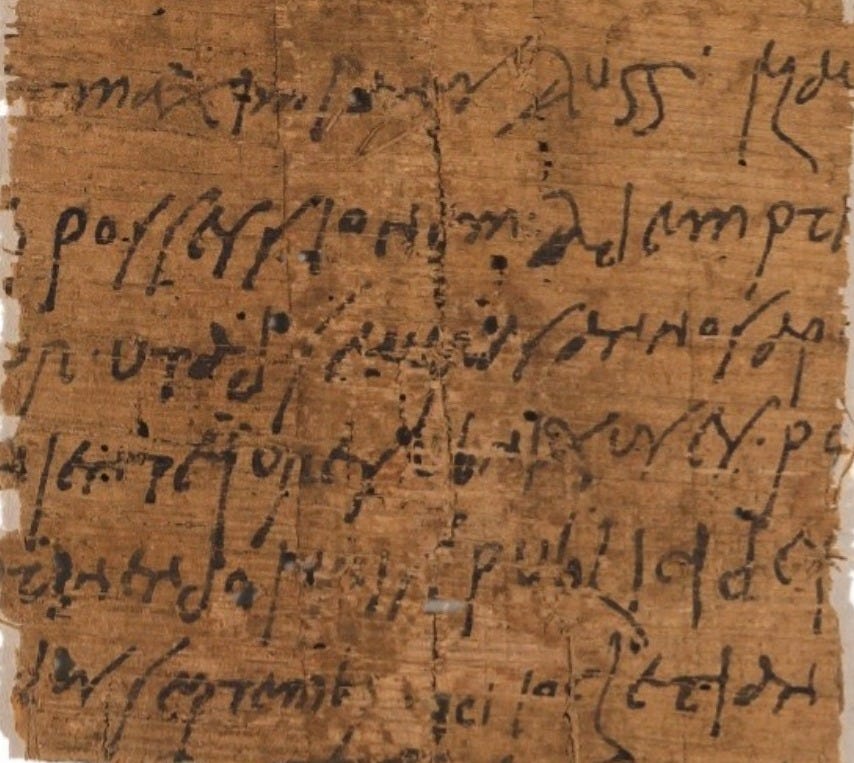
During the fifth and sixth centuries, administrative documents began to be written in a script using lower-case letters, spacing between words, cursive elements (known as ligatures), and rounded edges.39
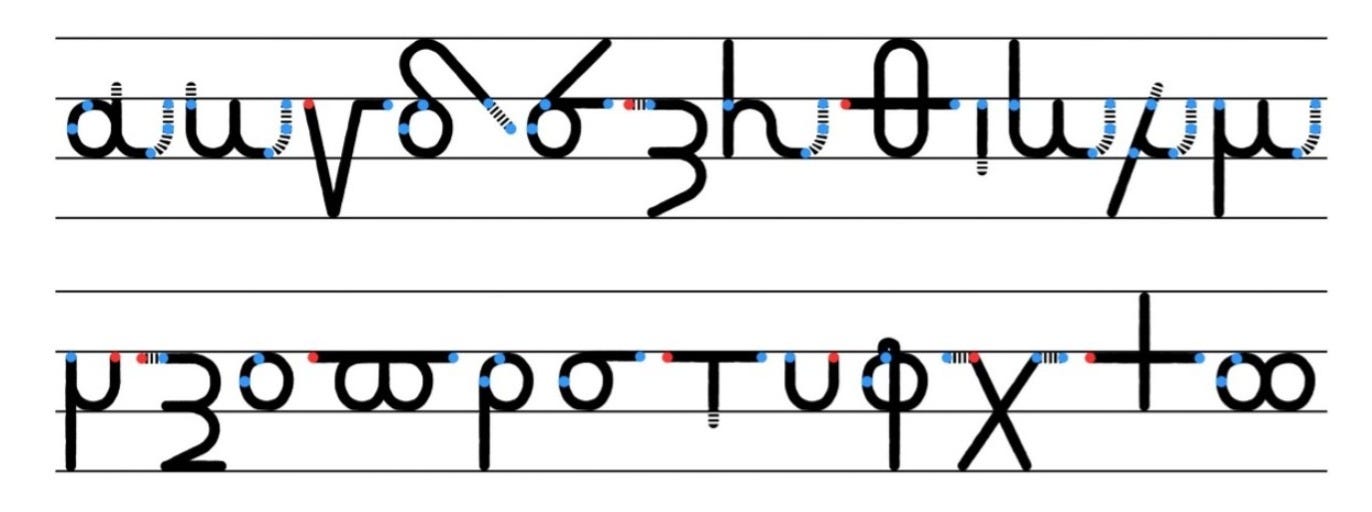
By the eighth century, this miniscule form (from the Latin, minuscula littera, meaning “a small letter”) was being taught to school children along with majuscule,40 and by the ninth century, scribes increasingly favored minuscule and began using it for new manuscripts.41
Where the New Testament was concerned, the benefits of miniscule made it a favorite of copyists.
In the ninth century, a monastery known as the Stoudios created a miniscule format acceptable for reproducing literary works like the New Testament, a script that was used to produce the oldest extant New Testament manuscript in 835 AD, the “Uspenski Gospels.”42
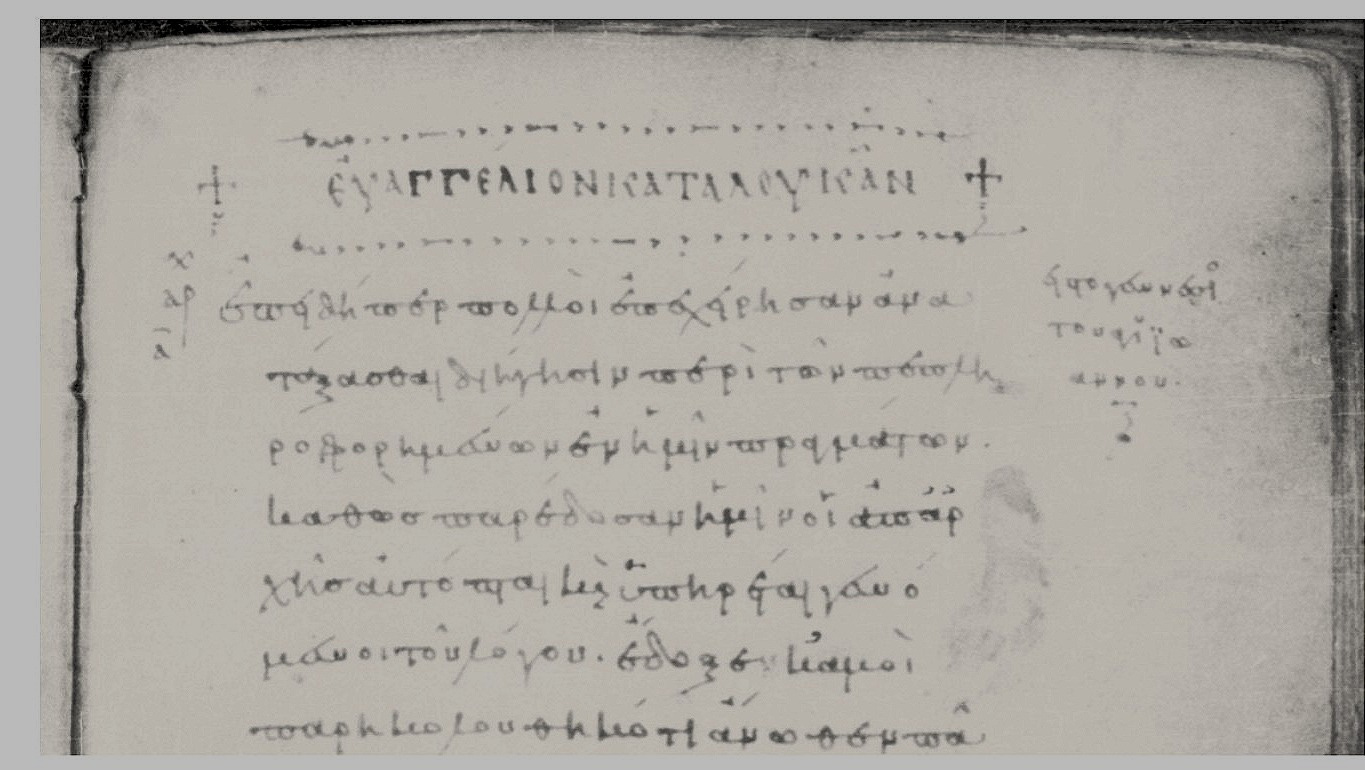
By the eleventh century, majuscule writing had nearly vanished.43
The result was a clear dividing line in time for manuscript handwriting types: majuscules from the second to early ninth centuries, majuscules and minuscules from the latter ninth through tenth centuries, and only minuscules from the eleventh century on.44
Conclusion
By examining how Greek New Testament manuscripts were produced and preserved, we gain a clearer understanding of how scholars evaluate their reliability.
The transition from papyrus to parchment, from scroll to codex, and from majuscule to minuscule writing provides a framework for dating manuscripts and assessing their historical value.
These features also expose a reality often overlooked by critics: the transmission of the New Testament was neither careless nor opaque. Still, an even more compelling line of evidence remains to be considered.
The next essay will focus on the sheer quantity and early dating of extant New Testament manuscripts, and demonstrate why this body of evidence far surpasses that of any other work from the ancient world.
NOTES:
“Extant,” Merriam-Webster, Merriam-Webster, Inc., https://www.merriam-webster.com/dictionary/extant.
Bruce M. Metzger, The Text of the New Testament: Its Transmission, Corruption, and Restoration, 2nd ed., 1968, PDF edition, 12.
J. H. Greenlee, “Text and Manuscripts of the New Testament,” in The Zondervan Pictorial Encyclopedia of the Bible, vol. 5, ed. Merrill C. Tenney (Grand Rapids: Zondervan, 1976), 701.
Ibid, 703.
“Codex Ephraemi Syri Rescriptus (C),” BibleGateway, accessed 23 Dec. 2025, https://www.biblegateway.com/resources/encyclopedia-of-the-bible/Codex-Ephraemi-Syri-Rescriptus.
Greenlee, “Text and Manuscripts,” 703.
Carroll Osburn, “The Greek Lectionaries of the New Testament,” in The Text of the New Testament in Contemporary Research, Leiden, The Netherlands: Brill, 2013, https://doi.org/10.1163/9789004236554_005.
Greenlee, “Text and Manuscripts,” 704.
Ibid, 698.
Ibid.
Bart D. Ehrman, “Textual Criticism of the New Testament,” in Hearing the New Testament, ed. Joel B. Green (Grand Rapids: Eerdmans, 1995), 131.
Greenlee, “Text and Manuscripts,” 702-703.
Todd Leibovitz, “Manuscript 101: Manuscript Materials,” The Center for the Study of New Testament Manuscripts, n.d., https://www.csntm.org/2023/02/09/manuscripts-101-manuscript-materials/.
Greenlee, “Text and Manuscripts,” 699.
Ibid.
Ibid.
Edward D. Andrews, “Greek Uncial (Majuscule) Manuscripts of the New Testament,” n.d., https://uasvbible.org/2022/02/02/greek-uncial-majuscule-manuscripts-of-the-new-testament.
Ibid.
Greenlee, “Text and Manuscripts,” 698.
H. Grady Davis, “Types of Writing Materials and Methods,” Britannica, 3 Nov. 2025, https://www.britannica.com/topic/biblical-literature/Types-of-writing-materials-and-methods.
Greenlee, “Text and Manuscripts,” 698.
Ibid.
“Codex,” Britannica, n.d., https://www.britannica.com/topic/codex-manuscript.
Greenlee, “Text and Manuscripts,” 698-699.
Andrews, “Greek Uncial (Majuscule) Manuscripts.”
Clark R. Bates, “Manuscripts 101: A Brief History of Greek Handwriting,” The Center for the Study of New Testament Manuscripts, n.d., https://www.csntm.org/2022/04/22/manuscripts-101-a-brief-history-of-greek-handwriting.
Ibid.
Ibid.
Greenlee, “Text and Manuscripts,” 700.
“Majuscule,” Britannica, n.d., https://www.britannica.com/topic/majuscule.
“Rustic capital,” Britannica, n.d., https://www.britannica.com/topic/rustic-capital.
Bates, “Manuscripts 101.”
Ibid.
Ibid.
Ibid.
Greenlee, “Text and Manuscripts,” 700.
Metzger, Text of the New Testament, 10-11.
Bates, “Manuscripts 101.”
Ibid.
Ibid.
Greenlee, “Text and Manuscripts,” 700.
Ibid.
Ibid.
Ibid.