

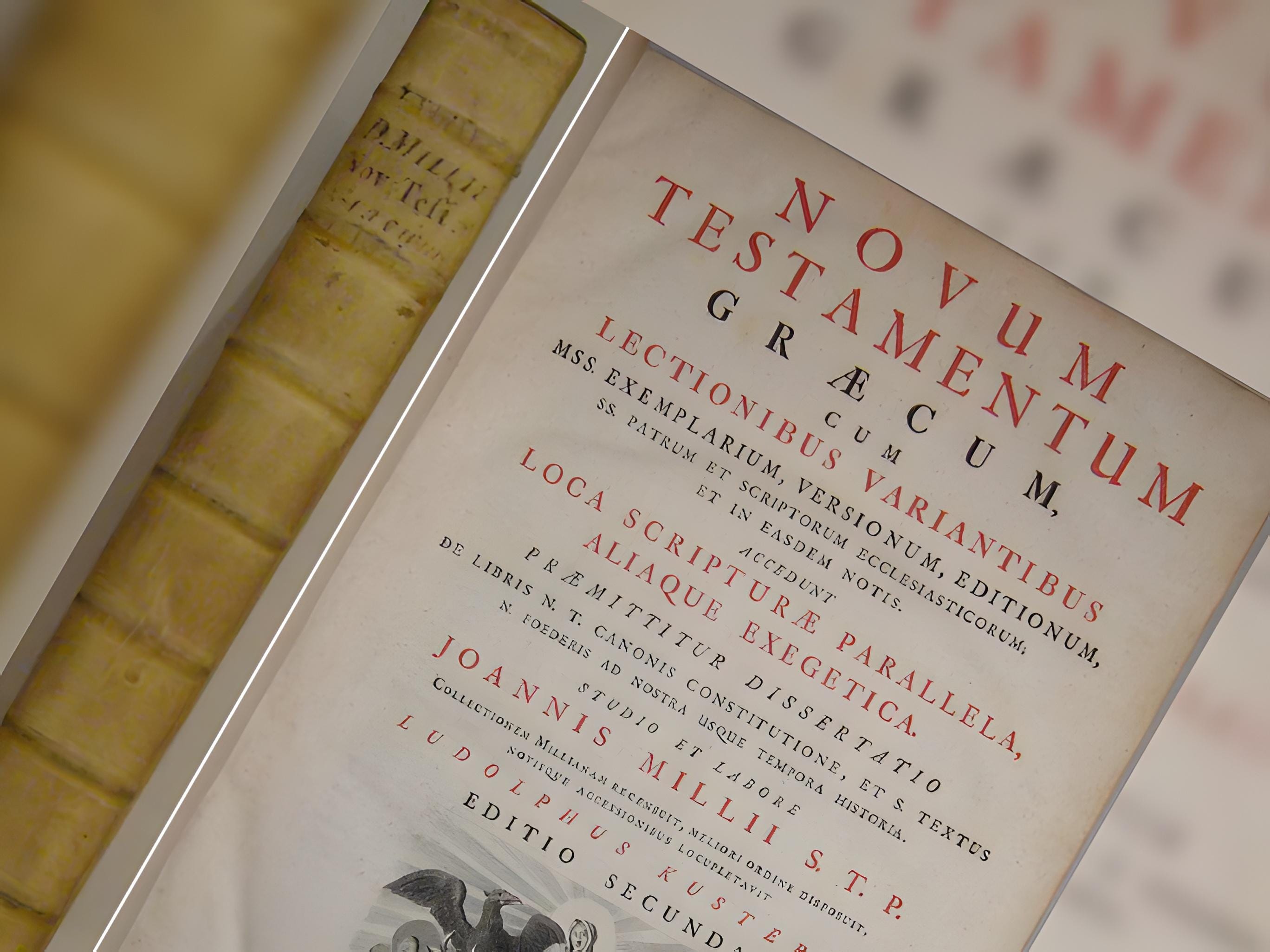
“Is the text of the New Testament reliable? The reality is there is no way to know.”1
It may surprise you to learn that this statement comes from a prominent New Testament scholar and former Christian named Bart Ehrman.
Ehrman, who now claims to be an agnostic, after years of studying the Greek manuscripts of the New Testament, concluded that it,
rather than being an inerrant revelation from God, inspired in its very words, [it is] a very human book with all the marks of having come from human hands: discrepancies, contradictions, [and] errors.2
Over time, the study of the New Testament’s foundational documents eroded Ehrman’s faith and eventually destroyed it altogether. He is far from the only person to experience this spiritual about-face.
Doubts about the fundamental reliability of the New Testament penetrate every pore of Western culture.

The result is legions of believers who have abandoned Jesus Christ and hordes of unbelievers who regard him a myth unworthy of serious consideration.3
The arguments of skeptics are convincing. Consider a few of their more oft-repeated claims:4
The total differences among Greek manuscripts range from 200,000-400,000, meaning there are more differences than there are words in the New Testament
Of the 5,700 Greek manuscripts in existence, “94 percent were produced 700 years after the originals”
We do not have the originals, the first copies of the originals, or the first copies of the first copies to use in determining the accuracy of the modern New Testament
Does this mean there really is no way to know if the New Testament is reliable? Not at all. When the full range of facts and arguments are considered, the challenges Ehrman highlights do not justify his conclusions.
The New Testament we have today is entirely trustworthy and accurately reflects the original words of its authors.
Early Access Note: At launch, long-form essays are available in full; future essays will be reserved for paid subscribers, who will also receive the full audio edition and printable PDF.
Addressing the claims of critics begins by learning more about the manuscripts themselves, how they differ, and how they make it possible to confidently determine the words of the original writings.
This 5-part essay series will aid in that process by accomplishing the following:
Essay 1 will identify the three sources of content for the New Testament
Essay 2 will provide an overview of the physical characteristics of existing Greek manuscripts
Essay 3 will spell out the quantity, coverage, and age of existing manuscripts
Essay 4 will outline the types and significance of manuscript variations
Essay 5 will explain why manuscript differences do not undermine the doctrines of biblical inspiration and preservation
In this essay:
Let us begin by reviewing the three sources of New Testament content.
Premium Resources for Paid Subscribers
Voiceover of Full Essay (via Podcast)
Printable PDF (download below)

The Three Sources of New Testament Content
The New Testament was written in a form of Greek known as Koine Greek. The term koine is a shortened form of koine glossa, meaning “common language.”
It emerged as the universal language of administration, commerce, and literature in Greece, Asia Minor, the Ancient Near East, Egypt, and beyond following Alexander the Great’s conquests of the Eastern Mediterranean.5
Determining the words of the New Testament, therefore, can most accurately be done by accessing these original Greek writings (known as the “autographs”).
Unfortunately, the autographs no longer exist, primarily due to the perishable nature of the material upon which they were written (more about material types in Essay 2).
All is not lost, however. The content of the New Testament lives on in three other sources:
Copies of the autographs in Koine Greek
Ancient translations into other languages
Quotations of early Church Fathers
1. Copies of the Original Greek Manuscripts
As the gospel spread, individuals and groups sought to obtain their own copies of New Testament books for reading and study. These early copies were accomplished in the same language in which the original books were written, Koine Greek.
Over the centuries, thousands of copies were made in various parts of the world. Beginning in the 16th century, scholars began gathering, comparing, and studying these manuscripts, a process known as textual criticism.
The total of these collected manuscripts form the primary source for and basis of the modern New Testament.
Subsequent essays will examine in detail the copying formats and writing materials used to produce these manuscripts as well as the quantity and age of manuscripts. A summary will be provided here.
Manuscript Forms
Greek manuscripts appear in three forms: direct copies, palimpsests, and lectionaries.
Direct copies are manuscripts made to recreate the words of New Testament alone, with no additional text or commentary.
Palimpsests are documents in which the original New Testament text was scraped away and overwritten with another text, though the underlying words remain discernible.6
Lectionaries contain specific New Testament passages that were read in church services at various times and contexts.7
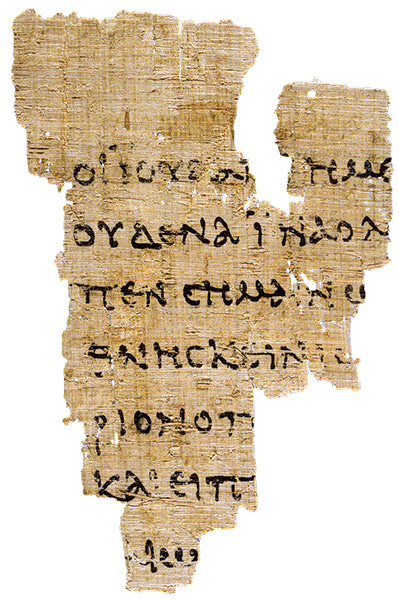
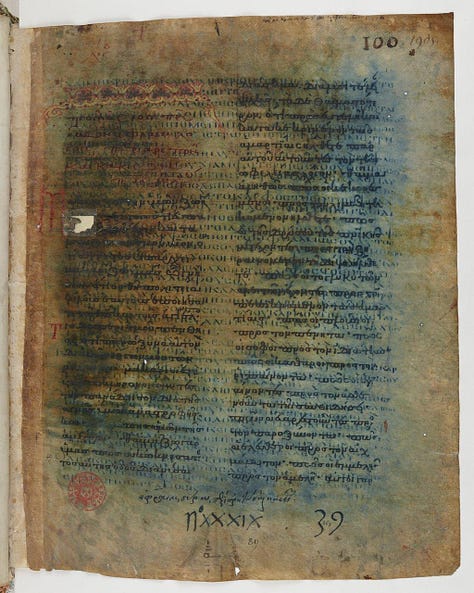
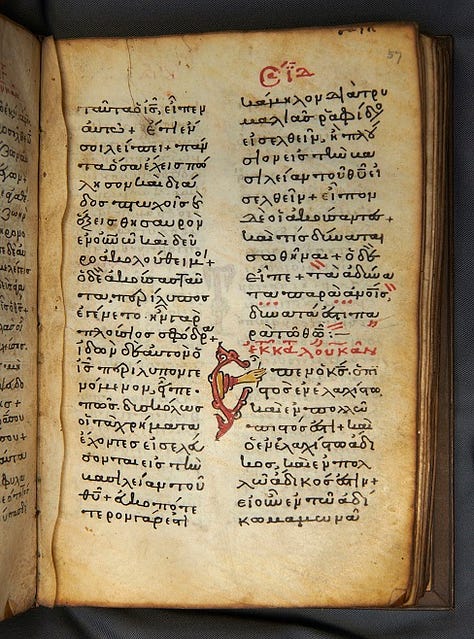
Top-bottom/left-right, Papyrus copy of John 18:31-33 known as P52, palimpsest Codex Ephraemi Rescriptus from the 5th century, and the Keble Greek Lectionary dated 11th-12th century. Images via public domain, CSNTM, and Keble College.


Manuscript Materials
New Testament manuscripts were written on either papyrus or parchment. Papyrus was a rough grade of paper made from the papyrus plant, a reed which grew in Egypt along the Nile.
Like modern paper, it deteriorated easily over time and is therefore found only in the earliest manuscripts.
Parchment, on the other hand, was much more durable being made from animal skins. Around the fourth century, parchment became the dominant material for New Testament copyists.8
Manuscript Counts
In terms of numbers, 5,700 Greek manuscripts have been identified, 135 papyri, 3,143 parchment, and 2,422 lectionaries.9
2. Ancient Translations into Other Languages
Beginning in the second century, as early Christians carried the gospel beyond the Greek-speaking world, the need arose to translate the New Testament into other languages.
The earliest translations were from the late second and early third centuries, and included languages like Syriac, a form of Aramaic spoken in Syria, Mesopotamia, and Persia, as well as Latin, the everyday language of the western Roman Empire.
Later, translations into Coptic (modern Egypt), Armenian (Armenia and surrounding areas), Ethiopic (Ethiopia/Eritrea), Georgian (Georgia), and Gothic (Romania/Bulgaria) were produced.10


According to New Testament scholar Daniel B. Wallace, existing Latin manuscripts exceed 10,000, and manuscripts in non-Latin languages total nearly 5,000.
Regarding the cumulative amount, he notes, “It would be safe to say that altogether we have about 20,000 handwritten manuscripts of the New Testament in various languages.”11
While translations do not include direct information on the underlying Greek text used to create them, they do provide clues as to the family of manuscripts to which they belong. This is helpful in evaluating the transmission history, age, and quality of various existing manuscripts.12 More about this in future essays.
3. Quotations of New Testament Passages by Early Church Fathers
The final source of New Testament content is the writing of early Church Fathers. Christian preachers and teachers of old wrote commentaries, apologetic volumes, and other works that quoted verses from the New Testament.
These quotations date from the second through fourth centuries and are based on Greek manuscripts that existed at that time.
The number of quotations is substantial. Wallace puts the final figure at more than one million.13 Regarding the breadth of New Testament content available, he quotes Bruce Metzger and Bart Ehrman:
If all other sources for our knowledge of the text of the New Testament were destroyed, [the quotations of Church Fathers] would be sufficient alone for the reconstruction of practically the entire New Testament.
Most quotations are in Greek and Latin, but some come from Syriac or other languages.14
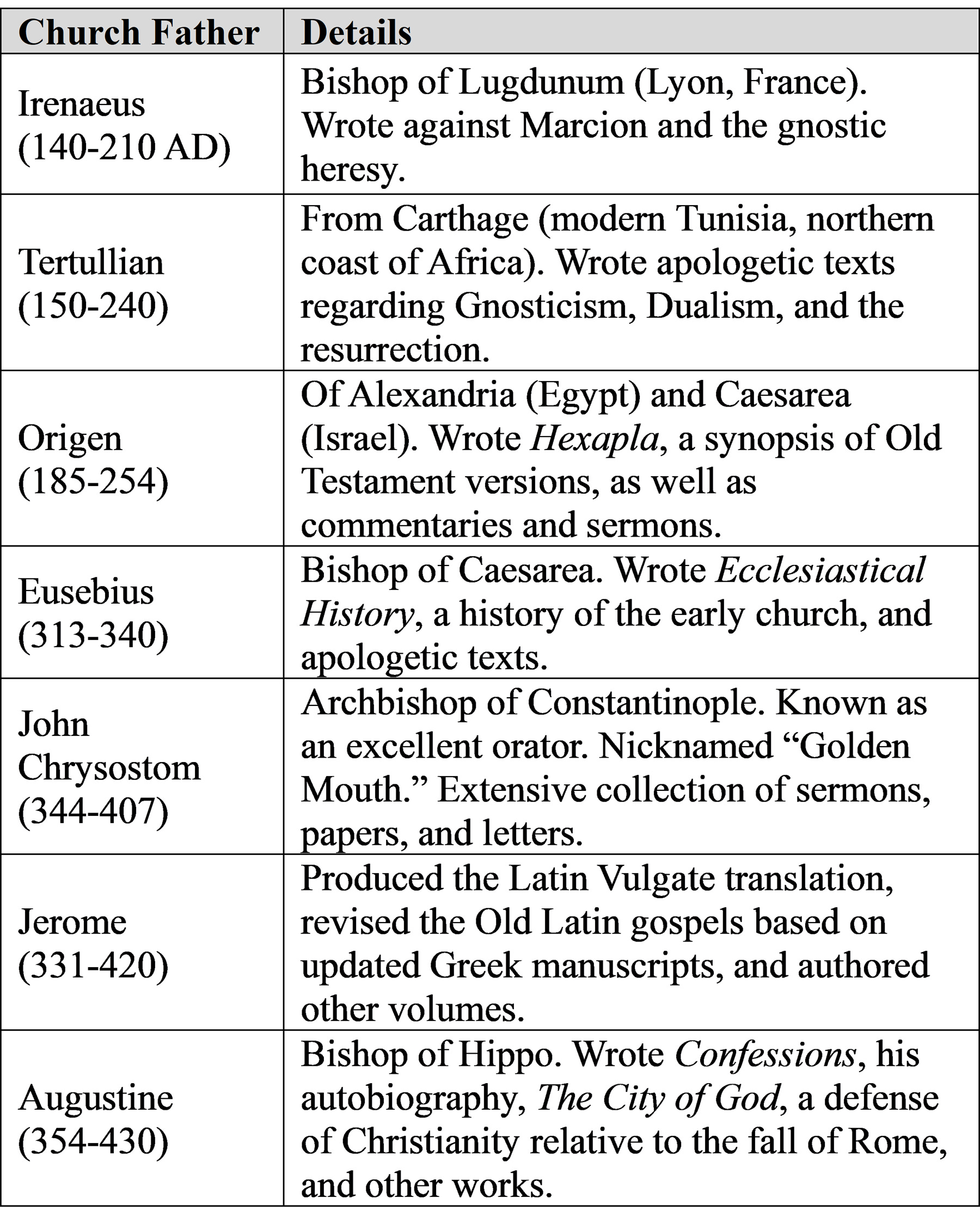
Church Fathers Providing Early New Testament Quotations
The table below lists selected Church Fathers providing New Testament quotations, including when they lived, where the ministered, and what they wrote.
The Value of the Writings of Fathers
But how do the writings of Church Fathers, none of which are in Koine Greek, assist in evaluating New Testament manuscript evidence?
The wording of the quotations themselves permits the Greek of the underlying manuscripts to be reconstructed, which makes it possible to identify the family of manuscripts being used. This, in turn, allows the changes that occurred over time, as well as the geographic location of those changes, to be pinpointed.
Ehrman notes15:
Unlike the scribes of our surviving Greek manuscripts and the early versions, the patristic writers can be fixed in time and space.
We know exactly when and where most of them lived; their quotations can therefore indicate with relative certainty how the text of the NT had been changed in different times and places.
Conclusion
Scholars and laymen alike doubt the New Testament because of its underlying manuscript evidence. Overcoming these doubts begins by understanding the full range of sources used to determine the content of the original writings.
These include not only manuscript copies in the original language, Koine Greek, but also ancient translations into other languages and quotes from Church Fathers. Taken together, these form a rich, mutually reinforcing body of evidence for the text of the New Testament.
In the next essay, we will examine more closely the Greek manuscripts themselves, a process that will provide further support the trustworthiness of today’s New Testament.
NOTES:
Robert B. Stewart, ed. “The Textual Reliability of the New Testament: A Dialogue.” The Reliability of the New Testament: Bart D. Ehrman and Daniel B. Wallace in Dialogue, Fortress Press, 2011, p. 27.
Bart D. Ehrman, “Excerpt: God’s Problem: How the Bible Fails to Answer Our Most Important Question — Why We Suffer.” WYSO, 19 Feb. 2008, https://www.wyso.org/2008-02-19/excerpt-gods-problem. Excerpted from God’s Problem: How the Bible Fails to Answer Our Most Important Question—Why We Suffer, HarperOne, 2008.
While Ehrman states that his doubts about the New Testament were not what finally led him out of the faith (he cites the question of suffering for that), it undoubtedly laid the foundation for this to occur. Once a man doubts the credibility of the Bible itself, his abandonment of his faith is not far away.
Stewart, Textual Reliability, 21.
Klaas Bentein and Chiara Monaco, “The Koine,” Oxford Bibliographies, Oxford University Press, November 22, 2024, https://www.oxfordbibliographies.com/display/document/obo-9780195389661/obo-9780195389661-0420.xml.
J. H. Greenlee, “Text and Manuscripts of the New Testament,” in The Zondervan Pictorial Encyclopedia of the Bible, vol. 5, ed. Merrill C. Tenney (Grand Rapids: Zondervan, 1976), 701.
Carroll D. Osburn, “The Greek Lectionaries of the New Testament,” in The Text of the New Testament in Contemporary Research, ed. Bart D. Ehrman and Michael W. Holmes (Leiden: Brill, 2013), https://doi.org/10.1163/9789004236554_005.
Greenlee, “Text and Manuscripts,” 699.
Katie Leggett and Greg Paulson, “How Many Greek New Testament Manuscripts Are There REALLY? The Latest Numbers,” Institute for New Testament Textual Research (blog), September 29, 2023, https://ntvmr.uni-muenster.de/intfblog/-/blogs/1891824.
Bart D. Ehrman, “Textual Criticism of the New Testament,” in Hearing the New Testament, ed. Joel B. Green (Grand Rapids: Eerdmans, 1995), 132.
Stewart, Textual Reliability, 33.
Greenlee, “Text and Manuscripts,” 704.
Stewart, Textual Reliability, 34.
Greenlee, “Text and Manuscripts,” 706.
Ehrman, “Textual Criticism,” 132.