

Is it possible to compile a single Greek New Testament that fully and accurately reflects the words of the original authors? Can we, two thousand years later, precisely reconstruct the writings of Matthew, John, Paul, and the other New Testament writers with the manuscript copies we have?
Skeptics say no.
One of the central reasons, they claim, is the fact that New Testament manuscripts exhibit hundreds of thousands of copying variations, what scholars call “variants,” which make determining the original wording impossible.
How do we respond to this?
It is true that existing manuscripts contain a substantial number of differences. The vast majority of these differences, however, are easily resolved and have little to no effect on meaning. How can this be true? This essay, the fourth in a series, will take up this question by accomplishing three things:
Define the term “variant” and provide an estimate of the total number in existing New Testament manuscripts.
Explain why the large number of reported variants is misleading.
Identify the two categories of variants and address the most frequently occurring type.
Let’s begin by defining variants and estimating how common they are in New Testament copies.
In this essay:
To read prior essays in this series, go to the New Testament Manuscripts series page.
Premium Resources
Printable PDF (download below)

The Definition and Number of Variants
So, what is considered a variant? New Testament scholar Daniel Wallace defines a variant as “any place among the manuscripts in which there is variation in wording, including word order, omission or addition of words, [or] spelling differences.”1 A variant, then, is what the average person would consider it to be: any difference between the written text of one document and another.
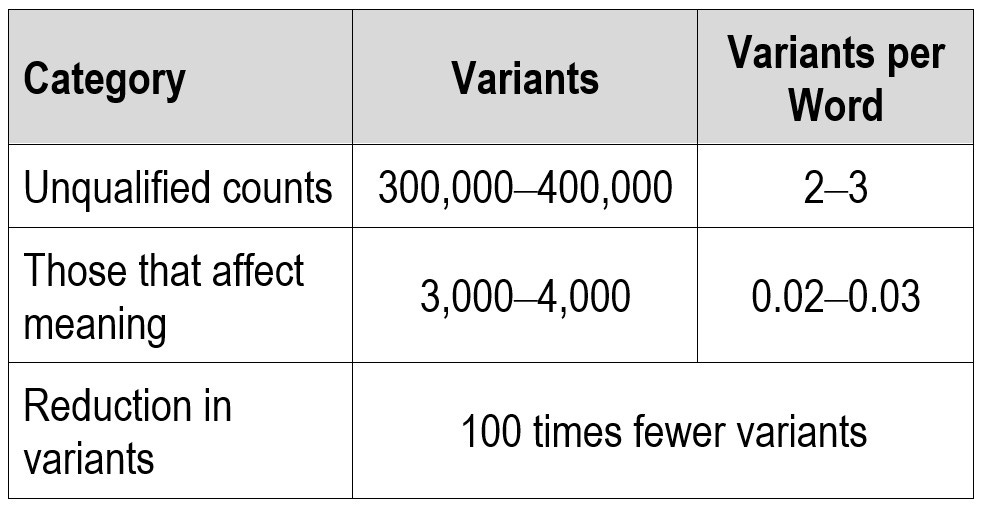
In terms of the Greek manuscripts of the New Testament, Wallace places the total variants at between 300,000 and 400,000.2 As there are approximately 140,000 words in the New Testament, this means there are two to three variants for every word.3 With numbers like that, it is easy to see how skeptics have been able to persuade so many that the New Testament is simply not reliable.
Unqualified Variant Claims

Why Variant Counts are Misleading
This number is not as alarming as it may first appear, however. Variant counts are misleading because they do not take into account two important facts.
A Lot of Manuscripts Means a Lot of Variants
For one thing, the large number of New Testament manuscripts helps explain the large number of reported variants. The more surviving copies of a text we possess, the more copying differences we can observe and catalog.
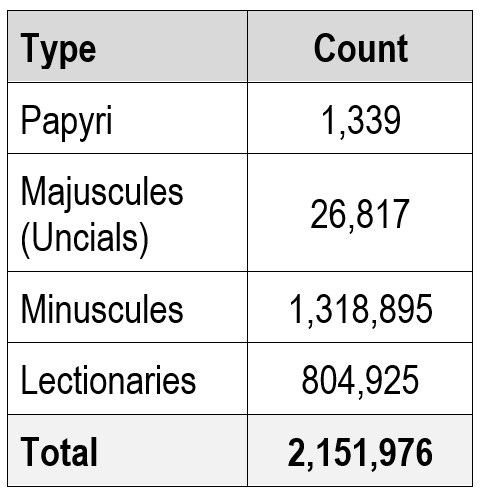
The tables below reveal both the number of total manuscripts and manuscript pages supporting the Greek New Testament. With such a vast reservoir of material—5,700 manuscripts and over 2.1 million pages—it is only reasonable that there would be a relatively high number of variants.
Extant Greek Manuscripts as of September 2023 (for type meanings, see this note4)
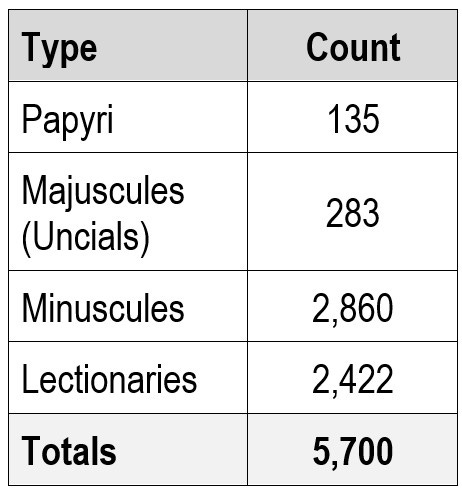
Manuscript Pages as of December 2025
Manuscripts and Variants for Homer’s Iliad
In essay 3, I mentioned that the support for Homer’s Iliad is so limited that some passages could only be referenced in a maximum of 10 manuscripts. In a 2017 book, Homeric scholar Martin West pointed this out and then commented on how so little manuscript support affects the total number of variants:
There are now places in the [Odyssey] where it is possible to cite the evidence of as many as five papyri. In the Iliad it can be as many as ten. The papyri almost never produce important new variants5 [emphasis added].
The lack of new variants is at least partially due to the lack of manuscripts. Wallace affirms this when he says, “No classical Greek or Latin text has nearly as many variants [as the Greek New Testament], because they don’t have nearly as many manuscripts.”6 The table below compares the total manuscript difference between the New Testament and Iliad, as well as the
Iliad vs NT – Manuscript Support
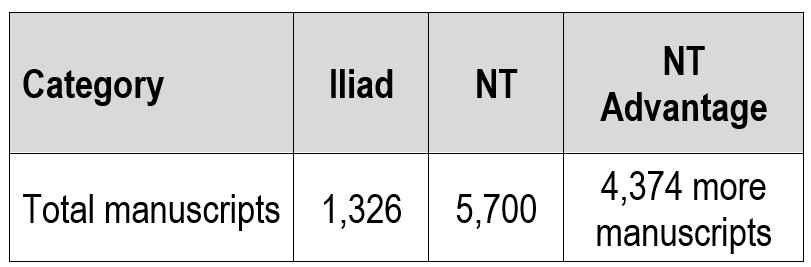
The reason there are so many variants in New Testament manuscripts is that there are so many New Testament manuscripts available. This is a strength of the New Testament documents, not a weakness.
The Vast Majority of Variants Are Trivial
When we look more closely into the variants themselves, we find the 300,000–400,000 figure decreasing rapidly. Bart Ehrman, a well-known skeptic of the New Testament documents and author of several books on the subject, states this openly: “The vast majority of the differences in our manuscripts are insignificant, irrelevant, and easy to explain.”7 And, regarding the instances where scholars disagree over more significant differences in a text, he observes,
We are fortunate not to have thousands upon thousands of such cases thrust upon us. Indeed, as nearly everyone at work in this field will concede, the vast majority of all textual problems are easily resolved, so that there is a consensus on most of the variant readings preserved in our manuscripts.8 [emphasis added]
Do not overlook this point. One of the most outspoken skeptics of the New Testament accepts that the “vast majority” of differences in manuscripts are “insignificant, irrelevant, and easy to explain,” and that “nearly everyone at work in this field will concede” this fact. Keep this in mind as we move forward.
But on what basis does he make this claim? How can hundreds of thousands of variants be accounted for so easily? Let’s break down the variant types to understand why.

Two Categories of Variants
Variants differ from one another, and not all variants affect the meaning of the text in the same way. Numerous categorizations could be given, but we will use a simplified form of Wallace’s approach and divide them into two groups: those that do not affect meaning and those that do.9
The remainder of this essay will address those that do not affect meaning. The next essay will address those that do.
Variants that Do Not Affect Meaning
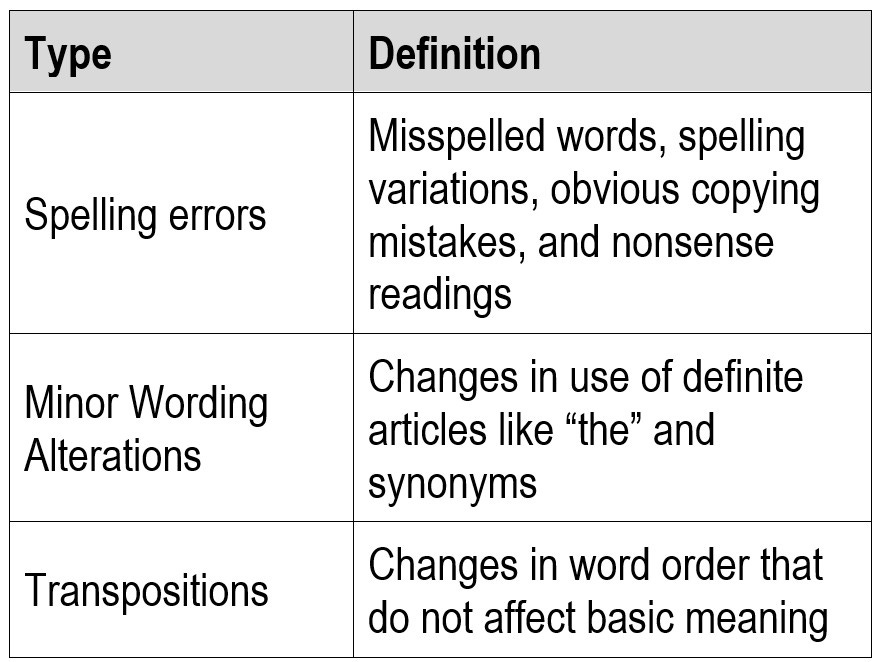
This variant class consists of genuine differences between copies, but those differences do not affect the reader’s understanding of the text in any way. Per Wallace, spelling errors, minor wording alterations, and transpositions are common types that fall into this category.
“The vast majority of the differences in our manuscripts are insignificant, irrelevant, and easy to explain.” Bart Ehrman, New Testament critic
Spelling Errors
“Of the hundreds of thousands of textual variants in New Testament manuscripts,” he says, “the great majority are spelling differences that have no bearing on the meaning of the text.”10
The most common spelling error relates to what is known as “the movable nu,” a Greek letter added at the end of words that precede a word starting with a vowel. This is roughly equivalent to the way “a” and “an” are used in English (“a” man, “an” honor). As in English, this affects only pronunciation, not meaning.
Moreover, as each of us knows from our own use of language, speling erors, other than whin they are so bad a wrd can no lnoger be identiphied, are inkonsequential to undahstanding the messege behind tha word [misspellings intentional].
Minor Wording Alterations
The second largest group of variants is non-spelling-related word changes that do not alter the translation or meaning. Wallace provides the following example:
A very common variant involves the use of the definite article with proper names. Greek can say “the Mary” or “the Joseph” (as in Luke 2:16), while English usage requires the dropping of the article. So, whether the Greek text has “the Mary” or simply “Mary,” English will always translate this as “Mary.”11
Transpositions
A third type is called transposition. A transposition occurs when the order of words or phrases changes during copying, so that the same elements are present but appear in a different sequence. This is a common variant in New Testament manuscripts, but due to the nature of the Greek language, it is not as consequential as it may seem.
Wallace explains:
Unlike English, Greek word order is used more for emphasis than for basic meaning. … You can tell where the subject is by its ending, regardless of where it stands in the sentence.
Take, for example, the sentence, “Jesus loves John.” In Greek, that statement can be expressed in a minimum of sixteen different ways, though every time, the translation would be the same in English. …
There may be a slight difference in emphasis, but the basic meaning is not disturbed.12
Variants that Do Not Affect Meaning
Impact on Variant Claims
Differences that result from spelling errors, minor wording variations, word order, and other trivial factors account for the vast majority of all New Testament variants. In fact, Wallace estimates that over 99% of all variants fall into this category. That means the number of variants that could potentially affect meaning is in the 3,000–4,000 range, not the 300,000–400,000 range. This amounts to roughly 0.02–0.03 variants per word, as opposed to the 2–3 variants per word suggested by the raw total count, about one-hundredth as many.
Qualified Variant Counts
But what about the 3,000-4,000? What kinds of variants fall under this category? And do those undermine the reliability of the New Testament? We will take up these questions in our next essay.
NOTES:
Stewart, Robert B., editor. “The Textual Reliability of the New Testament: A Dialogue.” The Reliability of the New Testament: Bart D. Ehrman and Daniel B. Wallace in Dialogue, Fortress Press, 2011, p. 32.
Ibid.
Ibid.
Papyri are early manuscript copies written on papyrus, a rough paper-like material made from the papyrus plant. Majuscules, also called uncials, are manuscripts written in large capital Greek letters. Minuscules are later manuscripts written in smaller, lower-case Greek script. Lectionaries are manuscripts containing selected New Testament passages arranged for reading in church services.
Martin L. West. “Editing the Odyssey.” The Winnowing Oar: New Perspectives in Homeric Studies, edited by Franco Montanari and Antonios Rengakos, Brill, 2017, 13, https://doi.org/10.1515/9783110559873-002.
Stewart, Textual Reliability, 34.
Bart D. Ehrman. “Textual Criticism of the New Testament,” in Hearing the New Testament, ed. Joel B. Green (Grand Rapids: Eerdmans, 1995), 130.
Ibid., 140.
Stewart, Textual Reliability, 39. Among others, he also notes a third category, those that affect meaning but are not viable. “These are variants found in a single manuscript or group of manuscripts that, by themselves, have little likelihood of reflecting the wording of the original text.” In other words, the differences amount to a translation that is nonsensical and could not possibly be correct. He cites variants associated with 1 Thessalonians 2:7 as an example.
Stewart, Textual Reliability, 39.
Ibid.
Stewart, Textual Reliability, 39-40. He adds here regarding other grammatical elements, “And once we factor in different verbs for ‘love’ in Greek, the presence or absence of little particles that often go untranslated, and spelling differences, the possibilities run into the hundreds. Yet all of them would be translated simply as ‘Jesus loves John.’”